Divorce in Nepal and procedural of Divorce in Nepal
Divorce in Nepal is a legal process that formally terminates a marital relationship between husband and wife. Governed by the National Civil Code 2074, divorce in Nepal has evolved significantly in recent years, reflecting changing social attitudes and legal reforms. The divorce rate in Nepal currently stands at approximately 4-5% of marriages, with over 40,183 couples filing for divorce in the fiscal year 2022/23 alone.
The concept of divorce in Nepal, while traditionally considered taboo in the country’s conservative society, is gradually gaining acceptance as more people become aware of their legal rights and individual freedoms. Kathmandu records the highest number of divorce cases, with approximately 13 couples filing for divorce daily, indicating a significant shift in urban Nepalese society.
Legal Framework Governing Divorce in Nepal
The divorce in Nepal process is primarily regulated by the National Civil Code 2074, specifically Sections 93 to 104, which comprehensively address all aspects of divorce proceedings. These provisions were introduced as part of broader legal reforms aimed at making family law more progressive, gender-sensitive, and justice-oriented.
The Muluki Civil Procedure Code 2074 complements these substantive provisions by outlining the procedural aspects of divorce in Nepal. This dual legal framework ensures that divorce in Nepal is conducted fairly, efficiently, and in accordance with established legal principles.
Key Legal Instruments for Divorce in Nepal:
| Legal Instrument | Relevance to Divorce |
|---|---|
| National Civil Code 2074 | Substantive provisions (Sections 93-104) |
| Muluki Civil Procedure Code 2074 | Procedural guidelines |
| District Court Rules | Implementation at local level |
Grounds for Divorce in Nepal
The divorce in Nepal law recognizes different grounds for husbands and wives, reflecting the country’s approach to addressing gender-specific concerns in marital disputes. Understanding these grounds is crucial for anyone considering divorce in Nepal.
Grounds for Husband to File Divorce in Nepal:
- Separation for Three Years: If the wife has been living separately for three or more consecutive years without the husband’s consent
- Deprivation of Maintenance: If the wife deprives the husband of maintenance costs or expels him from the house
- Physical or Mental Torture: If the wife commits acts likely to cause grievous hurt or severe physical/mental pain
- Adultery: If the wife is proven to have had sexual relations with another person
Grounds for Wife to File Divorce in Nepal:
- Abandonment: If the husband abandons the wife and his whereabouts are unknown
- Three-Year Separation: If the husband has been living separately for three consecutive years without the wife’s knowledge
- Adultery: If the husband has sexual relations with another woman
- Physical or Mental Torture: If the husband inflicts physical or mental torture
- Bigamy: If the husband remarries without the wife’s consent
- Marital Rape: If the husband forces sexual relations without consent
Types of Divorce Process in Nepal
Divorce in Nepal can be pursued through two main methods, each with distinct procedures, timelines, and requirements. Understanding these options is essential for anyone navigating the divorce in Nepal system.
Divorce by Mutual Consent in Nepal
Mutual consent divorce in Nepal is the most straightforward and efficient method when both spouses agree to end their marriage. This process emphasizes cooperation and typically results in less emotional stress and financial burden.
Key Features of Mutual Consent Divorce in Nepal:
- Timeline: 2-3 working days for completion
- Cost: Significantly lower (court fees: Rs 200-500)
- Stress Level: Minimal emotional and psychological impact
- Legal Representation: Often not required
- Success Rate: Nearly 100% when both parties genuinely agree
Step-by-Step Process for Mutual Consent Divorce in Nepal:
- Joint Petition Filing: Both spouses submit a joint petition to the District Court
- Document Submission: Marriage certificate, citizenship copies, and photographs
- Court Review: Judge verifies mutual consent and legal compliance
- Property Agreement: Both parties agree on property division
- Child Custody Arrangement: If applicable, custody and support terms are settled
- Final Hearing: Brief court appearance to confirm agreements
- Divorce Decree: Court issues final divorce order
Divorce by Court Order in Nepal
When spouses cannot reach mutual agreement, divorce in Nepal must be pursued through court proceedings. This process is more complex, time-consuming, and emotionally challenging.
Key Features of Court Order Divorce in Nepal:
- Timeline: Minimum 1 year, often longer
- Cost: Higher (court fees plus lawyer fees: NPR 30,000-150,000)
- Stress Level: High emotional and psychological impact
- Legal Representation: Essential
- Success Rate: Depends on evidence and legal grounds
Step-by-Step Process for Court Order Divorce in Nepal:
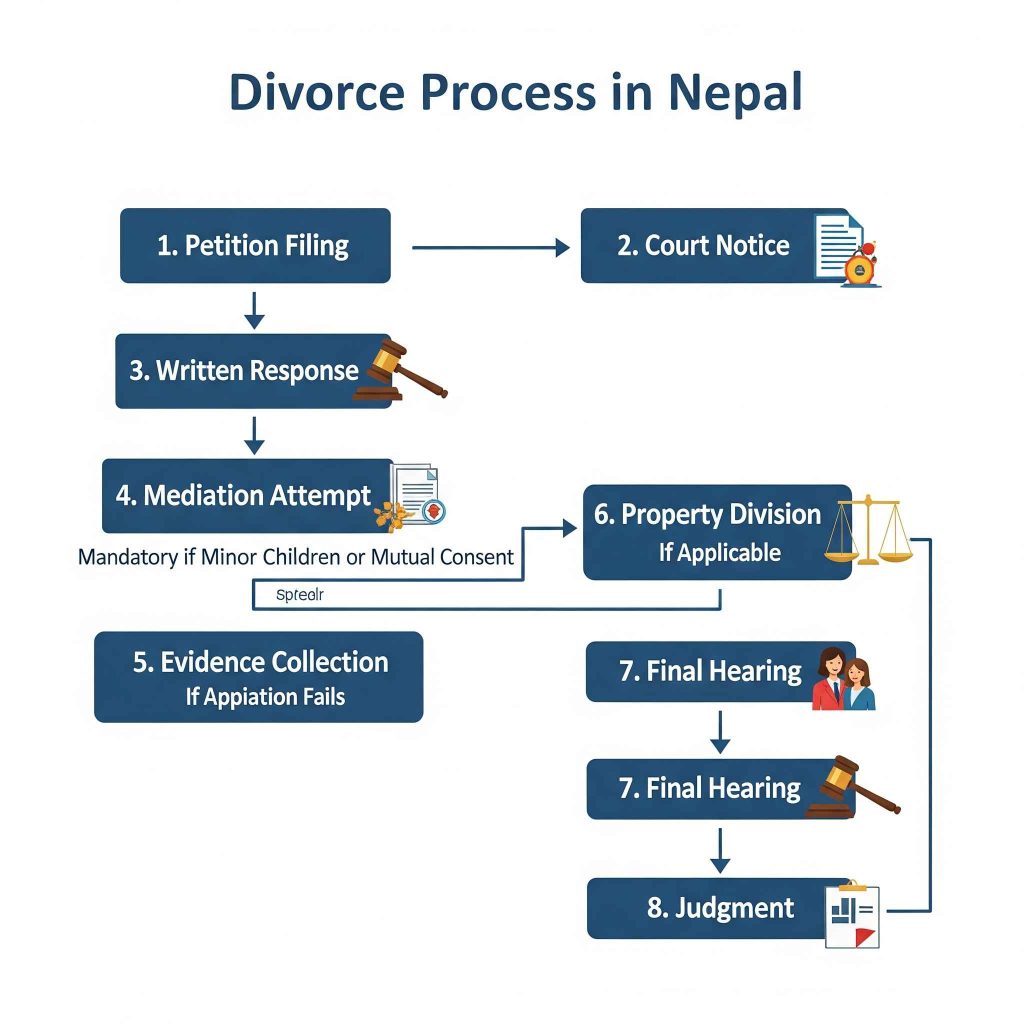
- Petition Filing: One spouse files divorce petition in District Court
- Court Notice: Court sends legal notice to the other spouse
- Written Response: Defendant files reply within stipulated time
- Mediation Attempt: Court tries to reconcile the parties
- Evidence Collection: Both parties present evidence and witnesses
- Property Division: Mandatory property settlement before divorce
- Final Hearing: Court examines all evidence and arguments
- Judgment: Court issues final divorce decision
Property Division in Divorce in Nepal
Property division is a critical aspect of divorce in Nepal that requires careful consideration and legal understanding. The National Civil Code 2074 provides clear guidelines for property division during divorce in Nepal.
Legal Principles for Property Division in Divorce in Nepal:
- Equal Distribution Principle: Property acquired during marriage through joint efforts is divided equally
- Joint Property Consideration: Property registered in both names or either name is partitioned according to law
- Coparcener Rights: Husband, wife, and children are considered coparceners for property division
- Mandatory Division: Property must be divided before divorce can be finalized
Types of Property Considered in Divorce in Nepal:
| Property Type | Division Rule |
|---|---|
| Joint Property | Equal division between spouses |
| Common Property | Shared among all coparceners |
| Ancestral Property | Subject to family partition laws |
| Individually Owned Property | Generally remains with owner |
Exceptions to Property Division in Divorce in Nepal:
The husband may not be compelled to provide property share or alimony under certain conditions during divorce in Nepal:
- If the wife deprived the husband of maintenance or expelled him from the house
- If the wife caused grievous hurt or severe physical/mental pain
- If the wife engaged in sexual relations with another person
Child Custody in Divorce in Nepal
Child custody arrangements are among the most emotionally charged aspects of divorce in Nepal. The law prioritizes the best interests of the child while considering various factors to ensure proper care and development.
Legal Framework for Child Custody in Divorce in Nepal:
Child custody after divorce in Nepal is governed by the National Civil Code 2017, particularly Part 3, Chapter-4. Nepalese courts are legally obligated to make custody decisions based solely on the best interests of the child.
Age-Based Custody Guidelines in Divorce in Nepal:
| Child Age | Custody Preference | Key Considerations |
|---|---|---|
| Under 5 years | Mother preferred | Mother’s care is considered essential for young children |
| 5-10 years | Mother preferred (if unmarried) | Child’s developing needs and stability |
| Above 10 years | Child’s opinion considered | Court considers child’s preference and maturity |
| Above 18 years | Child’s choice | Adult child can decide living arrangements |
Factors Considered in Child Custody Decisions for Divorce in Nepal:
- Child’s Age and Health: Physical and developmental needs
- Emotional Bond: Relationship with each parent
- Financial Stability: Ability to provide for the child
- Living Environment: Suitability of home and community
- Parental Capability: Emotional and parenting skills
- Child’s Preference: Especially for older children
Visitation Rights in Divorce in Nepal:
Even when one parent is granted primary custody, the non-custodial parent typically receives visitation rights. These rights are designed to maintain the child’s relationship with both parents while ensuring stability and consistency in the child’s life.
Costs and Timeline for Divorce in Nepal
Understanding the financial and time commitments involved in divorce in Nepal is crucial for proper planning and decision-making. The costs and timelines vary significantly based on the type of divorce in Nepal pursued.
Financial Costs for Divorce in Nepal:
| Cost Component | Mutual Consent Divorce | Court Order Divorce |
|---|---|---|
| Court Fees | Rs 200-500 | Rs 200-500 |
| Lawyer Fees | NPR 10,000-30,000 | NPR 30,000-150,000 |
| Documentation Costs | Minimal | Moderate |
| Miscellaneous Expenses | Low | Moderate to High |
| Total Estimated Cost | NPR 15,000-35,000 | NPR 50,000-200,000 |
Timeline for Divorce in Nepal:
- Mutual Consent Divorce: 2-3 working days
- Court Order Divorce: Minimum 1 year, often 2-3 years
- Complex Cases: Can extend beyond 3 years
Factors Affecting Timeline and Cost in Divorce in Nepal:
- Case Complexity: More complex cases take longer and cost more
- Court Backlog: District court workload affects processing time
- Cooperation Level: Uncooperative spouses increase costs and delays
- Property Disputes: Significant property disagreements extend proceedings
- Child Custody Battles: Custody disputes add complexity and time
Recent Trends and Statistics in Divorce in Nepal
The landscape of divorce in Nepal has evolved significantly in recent years, reflecting broader social changes and legal reforms. Understanding these trends provides valuable context for anyone navigating the divorce in Nepal system.
Key Statistics for Divorce in Nepal (2022-23):
- Total Divorce Cases: 40,183 cases filed nationwide
- Daily Average: 13 couples file for divorce daily in Kathmandu
- Divorce Rate: 4-5% of marriages end in divorce
- Urban vs Rural: Urban areas show higher divorce rates
- Age Trend: Younger couples (25-35) show increasing divorce rates
Emerging Trends in Divorce in Nepal:
- Increasing Acceptance: Social stigma surrounding divorce in Nepal is decreasing
- Women’s Empowerment: More women initiating divorce in Nepal
- Mutual Consent Preference: Rising preference for amicable divorce processes
- Legal Awareness: Increased knowledge of legal rights and procedures
- Urbanization: Higher divorce rates in urban centers like Kathmandu
Comparison with Global Divorce Trends:
| Region | Divorce Rate | Key Characteristics |
|---|---|---|
| Nepal | 4-5% | Low but rising, social stigma decreasing |
| South Asia | 1-3% | Generally low, cultural restrictions |
| Global Average | 40-50% | Varies widely by country |
| Developed Countries | 40-60% | Higher acceptance, legal accessibility |
Practical Tips for Navigating Divorce in Nepal
Successfully navigating divorce in Nepal requires preparation, understanding, and strategic planning. These practical tips can help individuals manage the process more effectively.
Before Filing for Divorce in Nepal:
- Legal Consultation: Seek professional legal advice before initiating proceedings
- Document Preparation: Gather all necessary documents (marriage certificate, citizenship, property documents)
- Financial Planning: Prepare for the financial impact of divorce
- Emotional Support: Arrange counseling or support systems
- Child Considerations: Plan for children’s well-being throughout the process
During the Divorce Process in Nepal:
- Maintain Documentation: Keep records of all communications and proceedings
- Follow Legal Procedures: Adhere strictly to court requirements and timelines
- Consider Mediation: Explore settlement options before litigation
- Protect Children’s Interests: Minimize children’s exposure to conflict
- Stay Organized: Maintain files of all legal documents and correspondence
After Divorce in Nepal:
- Legal Compliance: Ensure all court orders are followed
- Financial Adjustment: Adapt to new financial circumstances
- Co-parenting Cooperation: Maintain positive co-parenting relationships
- Emotional Recovery: Seek support for emotional healing
- Future Planning: Plan for long-term financial and personal goals
Frequently Asked Questions (FAQ) About Divorce in Nepal
What is the minimum time required for divorce in Nepal?
Divorce in Nepal through mutual consent can be completed in 2-3 working days, while court-ordered divorce typically takes a minimum of one year.
Where can I file for divorce in Nepal?
Divorce in Nepal must be filed in the District Court where the marriage was registered or where either spouse currently resides.
What are the main grounds for divorce in Nepal?
The primary grounds for divorce in Nepal include three-year separation, adultery, physical/mental torture, deprivation of maintenance, and abandonment.
How is property divided in divorce in Nepal?
Property acquired during marriage through joint efforts is divided equally in divorce in Nepal, with specific provisions for different types of property.
Can I get divorced in Nepal without being present?
Yes, divorce in Nepal can be initiated from abroad through a Power of Attorney authenticated by the Nepalese embassy in the respective country.
What documents are required for divorce in Nepal?
Required documents for divorce in Nepal include marriage certificate, citizenship certificates, photographs, and evidence supporting the divorce grounds.
How much does divorce cost in Nepal?
The cost of divorce in Nepal ranges from NPR 15,000-35,000 for mutual consent divorce to NPR 50,000-200,000 for court-ordered divorce.
Who gets child custody in divorce in Nepal?
Child custody in divorce in Nepal is determined based on the child’s best interests, with preference generally given to mothers for children under five years.
Can I get alimony in divorce in Nepal?
Yes, alimony can be awarded in divorce in Nepal based on financial dependency, property ownership, and income levels of both spouses.
What happens after divorce is granted in Nepal?
After divorce in Nepal is granted, the marriage registration certificate is canceled, property is divided, and both parties can remarry after the legal process is complete.
Conclusion: Navigating Divorce in Nepal Successfully
Divorce in Nepal represents a significant legal and personal journey that requires careful navigation, understanding, and preparation. The process, while complex, has become more accessible and socially acceptable in recent years, reflecting Nepal’s evolving legal and social landscape.
The key to successfully navigating divorce in Nepal lies in understanding your legal rights, preparing adequately, and seeking professional guidance when needed. Whether pursuing mutual consent divorce or court-ordered proceedings, being informed about the process, costs, timelines, and potential outcomes can help you make better decisions and achieve more favorable results.
Remember that divorce in Nepal is not just a legal process but a life transition that affects emotional, financial, and familial aspects of life. Approaching the process with preparation, patience, and professional support can help ensure a smoother transition to the next chapter of your life.
Call to Action
If you are considering divorce in Nepal, we strongly recommend consulting with a qualified divorce lawyer in Nepal Aastha Lohanee. An experienced divorce lawyer can provide personalized guidance, protect your legal rights, and help you navigate the complexities of the divorce in Nepal process more effectively.
Contact a reputable law firm in Nepal today to schedule a consultation and take the first step toward resolving your marital situation with confidence and legal protection.