Introduction: Understanding Work Permit Nepal
A work permit in Nepal is an essential document that must be obtained by foreign nationals who wish to engage in employment activities within the country’s borders. The process of obtaining a Nepal work permit is governed by specific regulations established by the Department of Immigration and the Department of Labor, which ensure that foreign employment contributes positively to the nation’s economic development.
For those seeking to work in Nepal, understanding the intricacies of the work permit process in Nepal is crucial. This comprehensive guide has been prepared to walk you through every step of the application procedure, requirements, and important considerations that must be addressed when seeking legal authorization to work in this Himalayan nation.
Legal Framework for Work Permits in Nepal
The foreign work permit Nepal system is primarily regulated under the Foreign Investment and Technology Transfer Act of 2019, alongside various provisions in the Labor Act of 2017. These legal frameworks establish the conditions under which foreign nationals may be employed in Nepal, with specific emphasis on knowledge transfer, skill development, and economic benefits for the country.
Additionally, the Nepal immigration laws provide further guidelines regarding the entry, stay, and employment of foreigners in Nepal. These regulations are periodically updated to reflect changing economic conditions and governmental priorities regarding foreign employment.
Eligibility Criteria for Nepal Work Permit
Not all foreign nationals are automatically eligible for a work permit in Nepal. The following criteria must typically be met:
- A valid job offer from a registered Nepali company or organization
- Professional qualifications or expertise that is not readily available in Nepal
- Minimum educational requirements (usually a bachelor’s degree or equivalent)
- Relevant work experience in the field of employment
- Clean criminal record
- Good health condition
It should be noted that certain sectors may have additional requirements or restrictions based on government policies and economic priorities.
Types of Work Permits in Nepal
Several categories of Nepal work visa arrangements exist, depending on the nature and duration of employment:
| Type of Permit | Duration | Renewable | Special Requirements |
|---|---|---|---|
| Short-term Work Permit | Up to 6 months | No | For specific projects or assignments |
| Long-term Work Permit | 1 year initially | Yes | Requires labor approval |
| Volunteer Work Permit | Up to 1 year | Yes | Requires registration with concerned authority |
| Research Work Permit | Up to 1 year | Yes | Requires research approval from relevant ministry |
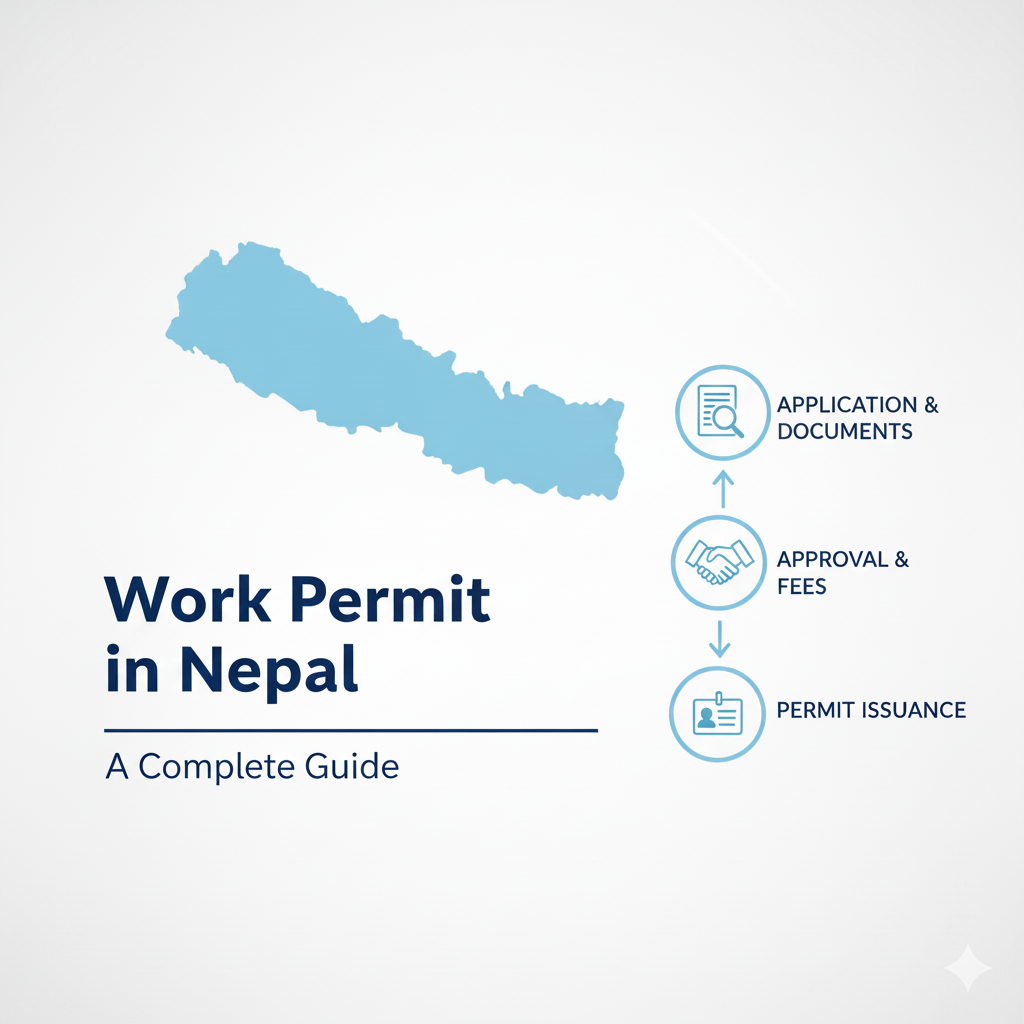
Step-by-Step Process for Obtaining Work Permit Nepal
1. Pre-Application Phase
Before the work permit application Nepal process can begin, several preliminary steps must be completed:
Firstly, a formal employment offer must be extended by a registered Nepali entity. This offer should clearly outline the position, responsibilities, salary, and duration of employment. Subsequently, the employer must obtain a pre-approval from the Department of Labor, which validates the necessity of hiring a foreign national for the position.
2. Document Preparation
The following documents are typically required for a work permit in Nepal:
- Completed application form (available from the Department of Immigration)
- Valid passport with at least six months validity
- Recent passport-sized photographs (2-4 copies)
- Employment contract duly signed by both parties
- Academic qualification certificates
- Professional experience certificates
- Health certificate
- Police clearance certificate from home country
- Company registration certificate of the employer
- Tax clearance certificate of the employer
- Labor approval from the Department of Labor
All documents not in English must be accompanied by certified translations.
3. Submission of Application
Once all documents are prepared, the application for a work permit Nepal can be submitted to the Department of Immigration in Kathmandu. The application must be submitted in person by the applicant or their authorized representative.
A processing fee, which varies depending on the applicant’s country of origin and duration of stay, must be paid at the time of submission. The current Nepal work permit cost structure is outlined in the table below:
| Country Category | Initial Fee (USD) | Renewal Fee (USD) |
|---|---|---|
| SAARC Countries | 50 | 30 |
| Other Developing Countries | 100 | 60 |
| Developed Countries | 200 | 100 |
4. Processing Period
After submission, the application undergoes a verification process that typically takes 2-4 weeks. During this period, the authorities may request additional information or clarification if needed.
5. Issuance of Work Permit
Upon approval, the work permit Nepal is issued, usually for an initial period of one year. The permit must be collected in person from the Department of Immigration.
Work Permit Renewal Process
The Nepal work permit renewal process must be initiated at least 30 days before the expiration of the current permit. The renewal process generally requires:
- Submission of a renewal application form
- Updated employment contract
- Proof of tax payments
- Work permit renewal fee
- Original work permit for cancellation
The renewal process is typically simpler than the initial application, provided that the employment conditions remain unchanged.
Rights and Limitations of Work Permit Holders
Holders of a work permit in Nepal are entitled to:
- Engage in employment with the specified employer
- Open bank accounts
- Obtain a driver’s license
- Access healthcare services
- Rent property
However, certain limitations apply:
- Employment is restricted to the specified employer and position
- Changing employers requires a new work permit application
- The permit does not provide a pathway to permanent residency
- Political activities are prohibited
Common Challenges and Solutions
Several challenges are commonly encountered during the work permit process Nepal:
1. Documentation Issues
Incomplete or improperly prepared documents can lead to delays or rejection. To avoid this, applicants should carefully review all requirements and consider seeking professional assistance from legal experts specializing in Nepal immigration law.
2. Labor Approval Delays
Obtaining labor approval can sometimes be time-consuming. Employers should initiate this process well in advance and ensure that all justifications for hiring a foreign national are clearly articulated.
3. Changing Regulations
Immigration policies in Nepal are subject to periodic changes. Staying updated with the latest requirements is essential for a smooth application process.
Special Considerations for Different Professions
Certain professions have specific requirements when applying for a work permit in Nepal:
1. Technical and Professional Experts
These applicants must demonstrate that their expertise is not readily available in Nepal and that they will contribute to knowledge transfer.
2. Volunteers and NGO Workers
Additional approvals from the Social Welfare Council may be required for those working with non-governmental organizations.
3. Researchers
Approval from the relevant ministry or research institution is necessary before a work permit can be issued.
Tax Obligations for Foreign Workers
All individuals holding a work permit Nepal are subject to Nepali tax laws on their worldwide income. Tax rates vary based on income levels, and proper registration with the tax authorities is mandatory.
Impact of Recent Policy Changes
Recent policy changes have affected the work permit process Nepal in several ways:
- Streamlined application procedures for certain categories of skilled workers
- Increased emphasis on digital documentation
- Enhanced security verification procedures
- Stricter enforcement of labor market tests
These changes reflect the government’s efforts to balance the need for foreign expertise with the protection of local employment opportunities.
Comparison with Other South Asian Countries
When compared to other South Asian nations, Nepal’s work permit system is characterized by:
- Moderate processing times
- Reasonable fee structure
- Clear documentation requirements
- Limited pathways to permanent residency
This comparison is useful for multinational companies planning regional operations and considering employment options across South Asia.
Future Trends in Nepal’s Work Permit System
Several trends are likely to shape the future of work permits in Nepal:
- Digitalization of application processes
- Increased focus on highly skilled professionals
- Potential introduction of points-based systems
- Enhanced bilateral agreements with key labor source countries
These developments reflect Nepal’s evolving economic priorities and its integration into the global labor market.
Practical Tips for a Smooth Application Process
Based on extensive experience with Nepal work permit applications, the following tips are recommended:
- Begin the process well in advance of the intended start date
- Ensure all documents are properly authenticated and translated
- Maintain copies of all submitted documents
- Follow up regularly with the authorities
- Consider engaging professional legal assistance
- Stay updated on policy changes through official channels
Conclusion
Obtaining a work permit in Nepal requires careful preparation and adherence to established procedures. While the process can be complex, proper planning and understanding of the requirements can significantly streamline the application process.
For those considering employment in Nepal, it is advisable to consult with legal professionals specializing in Nepal immigration law to ensure compliance with all applicable regulations and to navigate any potential challenges that may arise during the application process.
Frequently Asked Questions (FAQs)
Q1: How long does it take to get a work permit in Nepal?
A: The processing time for a work permit in Nepal typically ranges from 2 to 4 weeks, provided all documentation is complete and accurate. However, delays may occur during peak application periods or if additional verification is required.
Q2: Can I change employers with my current work permit?
A: No, a work permit Nepal is employer-specific. Changing employers requires a new work permit application, and the current permit must be cancelled before a new one can be issued.
Q3: Is a work permit in Nepal the same as a visa?
A: No, a work permit and a visa are separate documents. A work permit authorizes employment, while a visa authorizes entry and stay. Both are required for legal employment in Nepal.
Q4: Can my family accompany me on my work permit?
A: Yes, family members can obtain dependent visas based on your work permit, but they will not be authorized to work unless they obtain their own work permits.
Q5: What happens if my work permit application is rejected?
A: If your application is rejected, you will be informed of the reasons for rejection. You may address the issues and reapply, or consider alternative employment options.
Q6: Is it possible to convert a tourist visa to a work permit in Nepal?
A: No, a tourist visa cannot be converted to a work permit within Nepal. The work permit application must be initiated from outside the country.
Q7: Are there quotas for work permits in Nepal?
A: While there are no specific numerical quotas, the government prioritizes applications that demonstrate clear benefits to Nepal’s economy and skill development.
Q8: Do I need to speak Nepali to obtain a work permit?
A: Nepali language skills are not typically a requirement for obtaining a work permit, though they may be beneficial for certain positions and daily life in Nepal.
Call to Action
If you’re considering applying for a work permit in Nepal and require professional assistance, our team of experienced immigration lawyers is here to help. Contact us today for a consultation to ensure your application process is smooth and successful.