Historical Background
Nepal’s journey toward establishing a structured public procurement system began in the 1950s. The first formal legislation, the Financial Administration Regulations, was introduced in 1959, providing basic guidelines for government spending. However, these regulations lacked comprehensive procurement procedures.
In 1971, the government enacted the Supplies and Services Act, marking the first dedicated attempt to regulate public procurement. This was supplemented by the Construction Services Act of 1975, which specifically addressed infrastructure projects.
The watershed moment came in 2007 with the enactment of the Public Procurement Act (PPA), Nepal’s first comprehensive procurement legislation. The Public Procurement Regulations (PPR) followed in 2007 (amended in 2016), providing detailed implementation procedures.
Current Legal Framework
Public Procurement Act 2007 (PPA)
The PPA 2007 serves as the cornerstone of Nepal’s procurement system. It applies to all public entities and establishes fundamental principles of:
- Transparency and accountability
- Economy and efficiency
- Fair competition
- Non-discrimination
- Value for money
Public Procurement Regulations 2007 (amended 2016)
The PPR provides detailed procedures for implementation of the PPA, covering:
- Procurement planning requirements
- Bidding procedures and documentation
- Evaluation criteria
- Contract management provisions
- Dispute resolution mechanisms
Local Government Operation Act 2017
This legislation empowers local governments to conduct procurement activities within their jurisdictions, subject to central procurement laws. Local bodies must develop procurement regulations aligned with national standards.
Key Administrative Bodies
Public Procurement Monitoring Office (PPMO)
Established under the PPA as the central regulatory body for public procurement, the PPMO:
- Develops standardized bidding documents
- Monitors compliance with procurement laws
- Provides technical guidance to procuring entities
- Maintains a central procurement portal
- Reports to the Prime Minister’s Office
Review Committee
This independent committee handles procurement-related complaints and appeals. It can:
- Review procurement decisions
- Order corrective measures
- Recommend administrative actions against officials
National Vigilance Center
Operating under the Prime Minister’s Office, it monitors public procurement for corruption and irregularities.
Procurement Methods
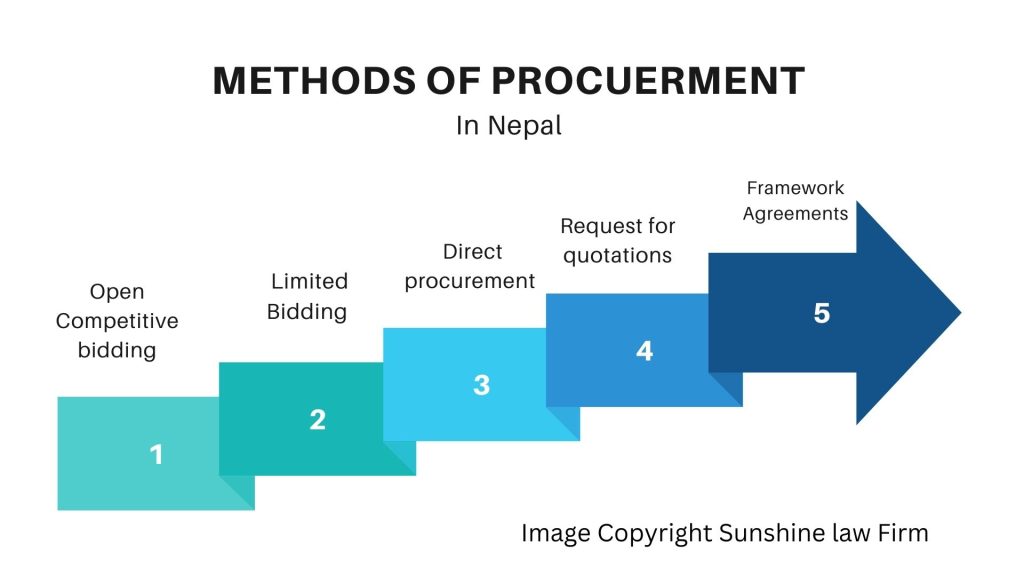
Nepal’s procurement framework recognizes several methods:
- Open Competitive Bidding: The default method for procurements above NPR 2 million
- Limited Bidding: Used when qualified suppliers are limited
- Direct Procurement: For emergency situations or small value purchases
- Request for Quotations: For procurement below NPR 2 million
- Framework Agreements: For recurring needs
E-Procurement Initiative
In 2016, Nepal launched the Electronic Government Procurement (e-GP) system, marking a significant modernization effort. The system aims to reduce paperwork, enhance transparency, and minimize corruption risks in the procurement process.
Frequently Asked Questions
What is the threshold for international competitive bidding?
For works contracts exceeding NPR 1 billion and goods/services exceeding NPR 150 million, international competitive bidding is mandatory.
Can foreign companies participate in public procurement in Nepal?
Yes, foreign companies can participate either independently or in joint ventures with local firms, subject to registration requirements under Nepalese law.
What are the main challenges in Nepal’s procurement system?
Key challenges include limited technical capacity among procurement officials, corruption risks, frequent policy changes, and implementation gaps between regulations and practice.
How are procurement disputes resolved?
Disputes are first reviewed by the head of the procuring entity. If unresolved, complaints can be filed with the Review Committee within 7 days of the decision.
Are there preferences for local suppliers?
The PPA provides domestic preference margins of up to 10% for locally manufactured goods and services provided by Nepalese firms.
Recent Developments
Nepal’s procurement system continues to evolve. Recent reforms include:
- Enhanced e-procurement capabilities
- Stronger provisions against conflict of interest
- Greater decentralization of procurement authority to local governments
- Integration of sustainability criteria in procurement decisions
Additional Resources
- Public Procurement Monitoring Office
- Ministry of Finance
- Nepal Law Commission
- Federation of Nepalese Chambers of Commerce and Industry
- Nepal Bar Association
- Transparency International Nepal
- World Bank – Nepal Procurement Portal
- Asian Development Bank – Nepal Projects
Our Publication
- Divorce process in Nepal
- FDI procedural in Nepal
- Merger and Acquisition guide
- NRB Merger and Acquisition guide
- Company registration in Nepal
- Commercial Contract Negotiation in Nepal
Conclusion
Nepal’s public procurement system has undergone significant transformation from basic financial regulations to a comprehensive legal framework centered on the Public Procurement Act 2007 and subsequent amendments. While challenges remain, the establishment of dedicated regulatory bodies and the implementation of electronic procurement systems demonstrate commitment to modernizing procurement practices.
For businesses and individuals engaging with Nepal’s public sector, understanding these regulations is essential for successful participation in government tenders and contracts. As Nepal continues its journey toward administrative federalism, further evolution of procurement laws can be expected, particularly in strengthening local government procurement capacity.
This blog serves as a general guide to public procurement law in Nepal. For specific procurement matters, consultation with legal experts specializing in Nepalese administrative law is recommended.