Civil Procedure in Nepal: Complete Guide to the Muluki Civil Procedure Code 2074

Introduction
Nepal’s civil justice system underwent a comprehensive transformation with the enactment of the Muluki Civil Procedure Code 2074 (2017), which works in conjunction with the Muluki Civil Code 2074. This modern legal framework replaced the traditional Muluki Ain system and established a unified, contemporary approach to civil litigation that aligns with constitutional principles and international best practices.
The civil procedure system in Nepal is designed to provide an efficient, fair, and accessible mechanism for resolving civil disputes while protecting the rights of all parties involved. The Muluki Civil (Code) Act, 2017 (2074) and the Muluki Civil Procedure (Code) Act 2017 (2074) came into effect on August 17, 2018, replacing the previous National Code system.
Understanding civil procedure is essential for legal practitioners, businesses, and individuals who may need to navigate the civil justice system in Nepal. The procedural framework ensures that civil disputes are resolved through established legal mechanisms that promote fairness, efficiency, and the rule of law.
Education Consultancy Registration in Nepal
Legal Framework and Structure
Muluki Civil Code 2074: Substantive Civil Law
The Muluki Civil Code, formally known as The National Civil (Code) Act, 2017 (2074) was authenticated on 16th October 2017 and came into force on 17th August 2018. This comprehensive legislation covers various areas of civil law including:
- Family Law: Marriage, divorce, child custody, and family relations
- Property Law: Real property, personal property, and inheritance
- Contract Law: Formation, performance, and breach of contracts
- Tort Law: Civil wrongs and remedies
- Commercial Law: Business transactions and commercial disputes
Muluki Civil Procedure Code 2074: Procedural Framework
The Civil Procedure Code establishes the procedural framework for civil litigation, including:
- Jurisdiction and Venue: Rules for determining which court has authority to hear a case
- Pleadings: Requirements for filing complaints, answers, and other court documents
- Service of Process: Methods for notifying parties about legal proceedings
- Discovery: Procedures for gathering evidence and information
- Trial Procedures: Rules governing the conduct of civil trials
- Judgment and Execution: Procedures for obtaining and enforcing court decisions
- Appeals: Process for challenging court decisions
Court System and Jurisdiction
Court Hierarchy
Nepal’s civil court system operates through a three-tier structure:
Supreme Court: The highest court with appellate jurisdiction over civil matters and constitutional issues
High Courts: Regional appellate courts that hear appeals from district courts
District Courts: First-instance courts with original jurisdiction over most civil matters
Jurisdiction Principles
The Muluki Civil Procedure Code 2074 provides specific provisions governing jurisdiction to prevent legal uncertainties. As a procedural law principle, jurisdiction ensures fairness, efficiency, and legal certainty in judicial proceedings.
Territorial Jurisdiction: Determines which geographic court has authority to hear a case based on:
- Location of the defendant’s residence
- Place where the cause of action arose
- Location of immovable property (for property disputes)
- Place where the contract was to be performed
Subject Matter Jurisdiction: Determines which level of court can hear specific types of cases based on:
- Value of the claim
- Type of relief sought
- Complexity of the legal issues involved
Pecuniary Jurisdiction: Establishes monetary limits for different court levels:
- District courts handle cases up to specified monetary limits
- Higher courts handle cases exceeding those limits
- Special jurisdiction for specific types of high-value cases
Civil Litigation Process
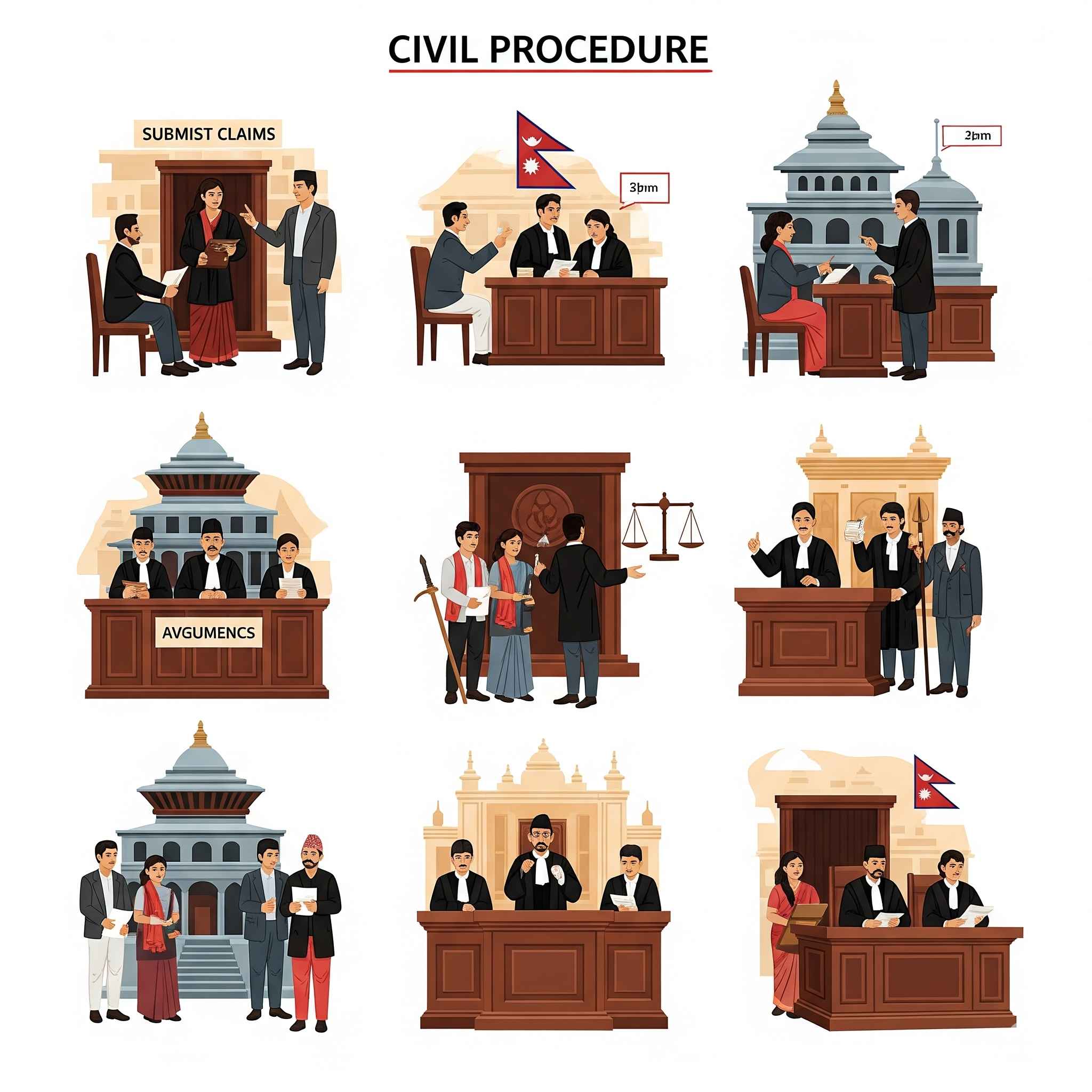
1. Pre-Litigation Considerations
Legal Consultation: Before initiating litigation, parties should:
- Assess the merits of their case
- Consider alternative dispute resolution methods
- Evaluate the likelihood of success
- Calculate potential costs and benefits
Limitation Periods: Civil actions must be filed within prescribed time limits:
- Different limitation periods apply to different types of claims
- Failure to file within the limitation period may bar the claim
- Special provisions for minors and persons under disability
Mandatory Mediation: Some disputes may require mandatory mediation before litigation:
- Family disputes often require mediation attempts
- Commercial disputes may benefit from alternative dispute resolution
- Court-annexed mediation programs available in some jurisdictions
2. Initiating Civil Proceedings
Filing the Complaint: Civil proceedings commence with the plaintiff filing a complaint in the competent first-instance court. Complaints must be filed in the district court where the immovable property is situated, if the dispute relates to immovable property.
Complaint Requirements:
- Clear statement of facts giving rise to the claim
- Legal basis for the claim
- Specific relief sought
- Supporting documents and evidence
- Proper court fees and stamps
Interim Relief: Plaintiffs may seek interim relief including:
- Temporary injunctions
- Preservation of property
- Appointment of receivers
- Other urgent measures to protect interests
3. Service of Process and Notice
Service Requirements: The defendants must be notified of the suit through proper service of process:
Methods of Service:
- Personal service on the defendant
- Service at defendant’s residence or place of business
- Substituted service when personal service is not possible
- Service by publication in exceptional cases
Service Documentation: Proper proof of service must be filed with the court to establish jurisdiction over the defendant.
4. Defendant’s Response
Answer Filing: Defendants must file their response within the prescribed time limit:
- Admission or denial of plaintiff’s allegations
- Affirmative defenses
- Counterclaims against the plaintiff
- Cross-claims against co-defendants
Default Judgment: Failure to respond may result in default judgment against the defendant.
5. Discovery and Evidence Gathering
Document Discovery: Parties may request disclosure of relevant documents from opposing parties.
Witness Depositions: Examination of witnesses under oath before trial.
Expert Evidence: Appointment of expert witnesses for technical or specialized matters.
Site Inspection: Court may order inspection of property or premises relevant to the dispute.
6. Pre-Trial Procedures
Case Management: Courts may conduct case management conferences to:
- Streamline issues for trial
- Explore settlement possibilities
- Set trial schedules
- Address procedural matters
Summary Judgment: Parties may seek summary judgment when there are no genuine issues of material fact.
Settlement Conferences: Courts may facilitate settlement discussions between parties.
7. Trial Proceedings
Opening Statements: Parties present their case overview to the court.
Plaintiff’s Case: Plaintiff presents evidence and examines witnesses to prove their claims.
Defendant’s Case: Defendant presents evidence and witnesses to refute plaintiff’s claims or establish defenses.
Rebuttal Evidence: Opportunity for parties to respond to opponent’s evidence.
Closing Arguments: Final arguments summarizing each party’s case and evidence.
8. Judgment and Decree
Court Decision: The court renders judgment based on:
- Evidence presented during trial
- Applicable law and legal principles
- Credibility of witnesses
- Legal standards for the type of case
Types of Relief: Courts may grant various forms of relief:
- Monetary damages
- Specific performance of contracts
- Injunctive relief
- Declaratory judgments
- Partition of property
9. Execution of Judgment
Execution Process: Successful parties may execute judgments through:
- Attachment and sale of debtor’s property
- Garnishment of wages or bank accounts
- Appointment of receivers
- Other enforcement mechanisms
Execution Procedures: Court officers assist in implementing court orders and collecting judgments.
Special Procedures
Family Law Matters
The Civil Code 2074 reformed divorce and family law in Nepal, making it more progressive, gender-sensitive, child-friendly, and justice-oriented. It recognized the right of both spouses to claim alimony, child custody, child support, property division, and debt allocation from each other after divorce.
Mediation Requirements: Family disputes often require mediation before litigation.
Custody and Support: Special procedures for determining child custody and support arrangements.
Property Division: Specific rules for dividing marital property upon divorce.
Commercial Disputes
Specialized Procedures: Commercial cases may involve:
- Complex financial evidence
- Expert testimony on business practices
- International commercial law principles
- Expedited procedures for urgent commercial matters
Arbitration: Commercial disputes may be resolved through arbitration:
- Domestic arbitration under Nepalese law
- International arbitration agreements
- Enforcement of arbitral awards
Property Disputes
Real Property Cases: Special procedures for:
- Boundary disputes
- Title disputes
- Partition of joint property
- Landlord-tenant disputes
Registration and Documentation: Emphasis on proper property registration and documentation.
Alternative Dispute Resolution
Mediation
Court-Annexed Mediation: Many courts offer mediation services:
- Trained mediators available
- Confidential settlement discussions
- Cost-effective resolution
- Preservation of relationships
Private Mediation: Parties may engage private mediators for dispute resolution.
Arbitration
Arbitration Act: Nepal has specific legislation governing arbitration:
- Domestic arbitration procedures
- International arbitration recognition
- Enforcement of arbitral awards
- Court supervision of arbitration process
Advantages of Arbitration:
- Faster resolution than litigation
- Expert arbitrators for specialized disputes
- Confidential proceedings
- Finality of awards
Appeals Process
Right to Appeal
Grounds for Appeal:
- Errors in law or legal interpretation
- Procedural irregularities affecting the outcome
- Insufficient evidence to support the decision
- Abuse of discretion by the trial court
Time Limits: Appeals must be filed within prescribed time limits from the date of judgment.
Appeal Procedure
Filing Requirements: Appeals must include:
- Specific grounds for appeal
- Supporting legal arguments
- Relevant portions of the trial record
- Proper court fees
Appellate Review: Appellate courts review:
- Legal correctness of the trial court’s decision
- Procedural compliance during trial
- Adequacy of evidence to support findings
- Appropriateness of the remedy granted
Enforcement and Execution
Domestic Enforcement
Execution Mechanisms:
- Attachment and sale of property
- Garnishment of income
- Arrest and detention in certain cases
- Appointment of receivers
Property Identification: Successful parties must identify debtor’s assets for execution.
International Enforcement
Foreign Judgments: Recognition and enforcement of foreign court judgments under specific conditions.
International Conventions: Nepal’s participation in international conventions affecting civil procedure.
Recent Developments and Reforms
Modernization Efforts
Technology Integration: Courts are gradually adopting electronic filing systems and digital case management.
Capacity Building: Ongoing training programs for judges and court staff to improve efficiency.
Access to Justice: Initiatives to improve access to justice for marginalized communities and remote areas.
Procedural Reforms
Case Management: Enhanced case management systems to reduce delays and improve efficiency.
Alternative Dispute Resolution: Expansion of mediation and arbitration services.
Specialized Courts: Development of specialized courts for specific types of disputes.
Practical Considerations for Legal Practitioners
Case Preparation
Thorough Investigation: Comprehensive fact-finding and evidence gathering before filing suit.
Legal Research: Understanding applicable substantive law and recent case law developments.
Strategic Planning: Developing litigation strategy based on case strengths and weaknesses.
Client Relations
Clear Communication: Explaining the litigation process, costs, and potential outcomes to clients.
Realistic Expectations: Helping clients understand the time and resources required for litigation.
Alternative Options: Discussing settlement and alternative dispute resolution possibilities.
Court Practice
Procedural Compliance: Strict adherence to court rules and deadlines.
Professional Conduct: Maintaining high standards of professional ethics and conduct.
Continuing Education: Staying updated on legal developments and procedural changes.
Challenges and Future Directions
Current Challenges
Case Backlog: Courts face significant backlogs affecting timely resolution of cases.
Resource Constraints: Limited resources for court infrastructure and personnel.
Geographic Access: Challenges in providing legal services to remote areas.
Language Barriers: Addressing linguistic diversity in legal proceedings.
Future Improvements
Judicial Reform: Ongoing efforts to modernize the judiciary and improve efficiency.
Legal Education: Enhancing legal education and professional development.
Technology Adoption: Implementing modern technology to streamline court operations.
Public Awareness: Improving public understanding of legal rights and procedures.
Conclusion
The civil procedure system in Nepal under the Muluki Civil Procedure Code 2074 represents a significant advancement in providing a modern, efficient framework for resolving civil disputes. The comprehensive procedural framework balances the need for thorough adjudication with the demand for timely and cost-effective resolution of disputes.
Success in civil litigation requires thorough understanding of both substantive law and procedural requirements. Legal practitioners must stay informed about ongoing developments in civil procedure and contribute to the effective functioning of Nepal’s civil justice system.
The emphasis on alternative dispute resolution, procedural fairness, and access to justice reflects Nepal’s commitment to creating a civil justice system that serves all citizens effectively. Through continued improvement and proper implementation, this framework can fulfill its promise of providing equal justice under law while promoting the peaceful resolution of disputes.
As Nepal continues to develop its legal institutions and strengthen its civil justice system, the procedural framework will undoubtedly continue to evolve. The foundation established by the current reforms provides a solid basis for addressing emerging challenges while maintaining the core principles that define an effective and fair civil justice system.
Note: This guide provides general information about civil procedure in Nepal. Specific cases may involve additional considerations, and legal practitioners should always consult current statutory provisions and recent case law for the most up-to-date requirements and procedures. Legal advice should be sought for specific civil matters.