
Legal Framework
The Patent, Design and Trademark Act, 2022 (1965) (PDTA) is the primary legislation governing trademark infringement in Nepal. The Act provides both civil and criminal remedies for unauthorized use of registered trademarks. Supporting legislation includes the National Civil Code, 2074 (2017), Customs Act, 2064 (2007), Consumer Protection Act, 2075 (2018), and Black Marketing and Other Social Offences Act, 2032.
The Department of Industry (DOI) serves as the primary administrative authority for trademark registration, opposition, cancellation, and infringement enforcement.
What Constitutes Trademark Infringement
Trademark infringement in Nepal occurs when:
- The infringing mark is identical or deceptively similar to a registered trademark
- The infringer uses it for commercial purposes
- It causes confusion, deception, or unfair competition in the market
- It is used without the consent or license of the registered owner
- The trademark is copied or used without transforming ownership or obtaining written permission
Three-Tier Remedy System
Nepal provides three categories of remedies for trademark infringement:
| Remedy Type | Authority | Key Features |
|---|---|---|
| Administrative | Department of Industry (DOI) | Complaint filing, investigation, interim orders, confiscation |
| Civil | District Court/High Court | Injunctions, damages, account of profits |
| Criminal | Police/Public Prosecutor/District Court | Fines up to NPR 100,000, imprisonment up to 1 year |
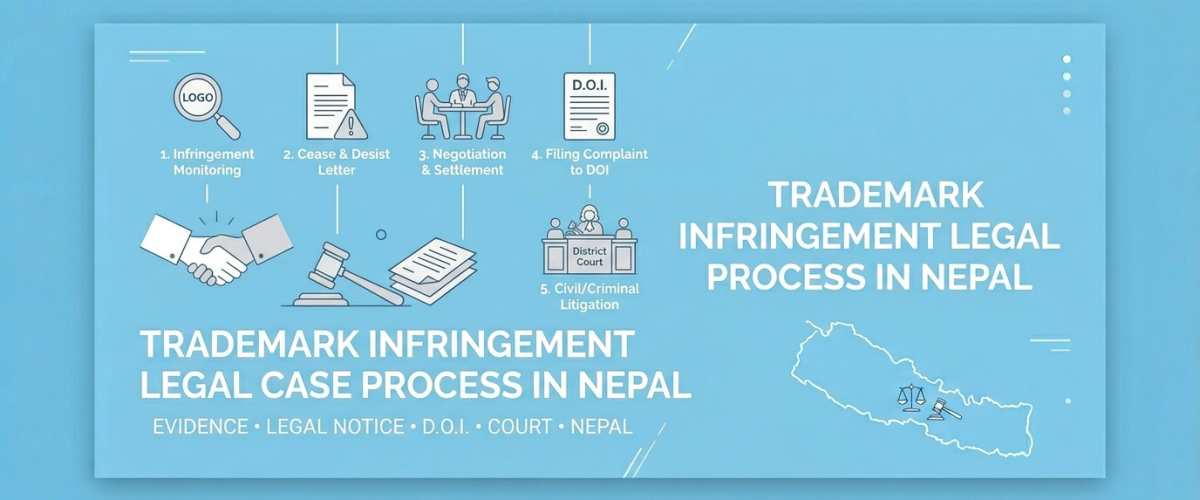
Step-by-Step Legal Case Process
Stage 1: Pre-Litigation Assessment (1-2 weeks)
Trademark Search and Evidence Collection:
- Conduct comprehensive trademark search to confirm registration status
- Gather evidence of infringement including:
- Samples of infringing products/packaging
- Advertisements and promotional materials
- Purchase receipts and invoices
- Photographs of infringing use
- Online listings and digital evidence
- Business records showing financial damages
Cease and Desist Notice:
- Draft formal cease and desist letter demanding immediate cessation of infringing activities
- Specify response deadline (typically 7-15 days)
- Include trademark registration details and evidence of infringement
- Warn of potential legal action if infringement continues
Stage 2: Administrative Complaint to DOI (8-14 months)
Filing Requirements:
- File complaint with Department of Industry, Industrial Property Branch
- Submit within reasonable time of discovering infringement (recommended within 35 days per Section 27 of PDTA)
- Include:
- Copy of trademark registration certificate
- Detailed complaint stating grounds of infringement
- Evidence of unauthorized use
- Power of Attorney (if represented by attorney)
- Evidence of financial losses or damages
DOI Process:
- Registration of Complaint – DOI acknowledges receipt and assigns case number
- Notice to Infringer – DOI serves notice to alleged infringer requiring response
- Investigation – DOI examines evidence and may conduct market inquiries
- Interim Relief – DOI may issue interim orders to halt production/distribution
- Hearing – Both parties present arguments (each party allowed up to two postponements)
- Decision – Director General issues written decision within 8-14 months typically
Possible DOI Outcomes:
- Order infringer to cease unauthorized use
- Confiscation of infringing goods and products
- Imposition of fine up to NPR 100,000 (Section 19, PDTA)
- Award of damages under Section 25 (though calculation mechanism not standardized)
- Dismissal of complaint if infringement not established
Appeal: Dissatisfied parties may appeal DOI decision to High Court within 35 days.
Stage 3: Civil Litigation (1-3+ years)
If administrative remedies prove insufficient, trademark owners may file civil suit in District Court.
Jurisdiction:
- District Court – Primary jurisdiction for trademark infringement cases
- High Court – Appeals from District Court decisions
- Supreme Court – Final appellate jurisdiction
Civil Remedies Available:
| Remedy | Description | Legal Basis |
|---|---|---|
| Injunction | Court order restraining further infringement | National Civil Code, Section 26(3) |
| Damages | Compensation for financial losses suffered | PDTA Section 25 |
| Account of Profits | Recovery of profits earned by infringer | General civil principles |
| Destruction of Goods | Court-ordered seizure and destruction of counterfeit products | PDTA enforcement provisions |
| Cost Award | Recovery of legal fees and litigation costs | Civil procedure rules |
Civil Procedure:
- Filing of Plaint – Submit complaint with supporting documents and court fees
- Preliminary Hearing – Court examines prima facie case for interim relief
- Interim Injunction – Court may grant temporary injunction pending final decision
- Evidence Stage – Parties submit affidavits, documents, and expert testimony
- Final Hearing – Oral arguments presented before judge
- Judgment – Court issues final order with remedies
- Execution – Winning party enforces judgment through court execution mechanisms
Stage 4: Criminal Prosecution (Variable Timeline)
Criminal proceedings may run parallel to civil action or be pursued independently.
Offenses and Penalties:
| Offense | Penalty | Legal Provision |
|---|---|---|
| Unauthorized use of registered trademark | Fine up to NPR 100,000 + imprisonment up to 1 year | PDTA Section 19 |
| Counterfeit production/sale | Seizure of goods + additional penalties | PDTA enforcement |
| False representation of trademark ownership | Fine + cancellation of application | PDTA Section 18 |
| Repeat offense | Higher penalties and stricter enforcement | General sentencing principles |
Criminal Process:
- Filing FIR – File First Information Report with police or complaint with DOI
- Police Investigation – Authorities conduct raids and seize infringing goods
- Prosecution – Public prosecutor files charge sheet in District Court
- Trial – Court examines evidence and hears witnesses
- Judgment – Acquittal or conviction with sentencing
- Appeal – Appeal to High Court and Supreme Court if convicted
Stage 5: Customs and Border Protection
Trademark owners may register their marks with Nepal Customs to prevent import/export of counterfeit goods.
Process:
- Register trademark with Customs Office under IPR protection rules
- Submit application with registration certificate and product details
- Customs monitors shipments and detains suspected counterfeit goods
- Customs notifies rights holder for verification and further action
- Infringing goods may be seized and destroyed
Legal Basis: Customs Act, 2064 (2007) and Import/Export Control Act
Landmark Judicial Cases
Kansai Nerolac Paints Ltd. v. Rukmini Chemical Industries Pvt. Ltd. (NKP 2077, Decision No. 10561):
Established that similarity assessment in trademarks (words, symbols, logos, phonetics) is valid ground for refusal or cancellation. Bad faith registration invalidates statute of limitations for cancellation.
Madan Lamsal v. Repsona Publication Pvt. Ltd. (NKP 2068, Decision No. 8686):
Established that only formally registered trademarks receive legal protection in Nepal, irrespective of duration of prior use.
Noor Pratap Rana v. Basnet Footwear (NKP 2062, Decision No. 7536):
Clarified that valid registration certificate is crucial for legal protection; mere prior use without registration may not grant exclusive rights.
Amrit Distilleries Pvt. Ltd. v. Facebook Inc. (NKP 2075):
Recognized “FACEBOOK” as well-known mark entitled to cross-class protection even without specific registration in all classes.
Perfect Blends (Nepal) Pvt. Ltd. v. VISA International (NKP 2076):
Upheld protection of well-known trademarks with cross-class protection, citing TRIPS Agreement Articles 16(2) and 16(3).
Timeline Summary
| Stage | Duration | Key Actions |
|---|---|---|
| Pre-litigation | 1-2 weeks | Evidence collection, cease and desist notice |
| DOI Administrative | 8-14 months | Complaint filing, investigation, hearing, decision |
| Civil Litigation | 1-3+ years | Court proceedings, injunction, damages |
| Criminal Proceedings | Variable | Police investigation, prosecution, trial |
| Appeals | Additional 1-2 years | High Court and Supreme Court review |
Cost Structure
| Component | Estimated Cost (NPR) |
|---|---|
| DOI complaint filing | 1,000 – 2,000 |
| Court filing fees | As per civil procedure regulations |
| Legal counsel fees | Market-dependent (typically 50,000 – 500,000+) |
| Evidence/expert fees | Case-specific |
| Trademark search | 5,000 – 15,000 |
| Power of Attorney registration | 10 |
| Civil damages | Determined by court |
| Criminal fines | Up to 100,000 per case |
Strategic Recommendations
- Early Registration: Register trademarks promptly with DOI to establish legal protection
- Market Monitoring: Regularly monitor market and online platforms for potential infringements
- Documentation: Maintain comprehensive records of trademark use, sales, and marketing
- Customs Registration: Register with Customs Office for border protection against counterfeit imports
- Swift Action: Initiate legal proceedings promptly upon discovering infringement to prevent further damage
- Professional Representation: Engage qualified IP attorneys for complex infringement cases
- Evidence Preservation: Ensure proper chain of custody for all evidence, with translations for foreign documents
Important Considerations
- Well-Known Marks: Even unregistered well-known trademarks receive protection under Nepalese law and TRIPS Agreement obligations
- Cross-Class Protection: Well-known marks are protected across dissimilar goods/services if use could cause confusion
- Burden of Proof: Trademark owner must establish ownership, unauthorized use, and likelihood of confusion
- Statute of Limitations: While PDTA does not specify strict timelines, prompt action is advised to avoid laches defense
- Parallel Proceedings: Administrative, civil, and criminal remedies can be pursued simultaneously or sequentially depending on case strategy