
Foreign Direct Investment (FDI) in Nepal offers international investors opportunities to establish businesses and contribute to economic development. Understanding the FDI process, legal requirements, registration procedures, and compliance obligations is essential for foreign investors planning to invest in Nepal. This guide explains the complete FDI process, required documents, applicable laws, costs, timelines, and post-registration requirements for foreign investors in Nepal.
Foreign Direct Investment (FDI) in Nepal requires registration with the Department of Industry, compliance with Foreign Investment and Technology Transfer Act, submission of required documents, and adherence to sectoral regulations. This guide explains the complete FDI process in Nepal.
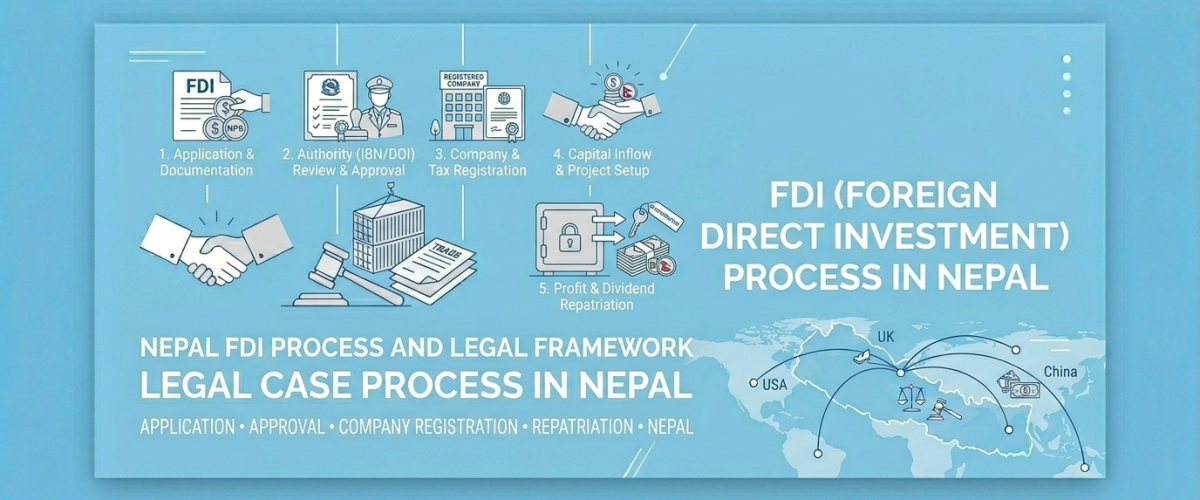
Steps to Complete FDI Process in Nepal
- Step 1: Determine Investment Sector and Eligibility
- Step 2: Register Company at Office of Company Registrar
- Step 3: Obtain FDI Approval from Department of Industry
- Step 4: Open Foreign Currency Account at Commercial Bank
- Step 5: Bring Investment Amount and Convert to NPR
- Step 6: Complete Post-Registration Compliance Requirements
What is FDI Process in Nepal?
The FDI process in Nepal refers to the systematic procedure through which foreign investors establish business operations, bring capital investment, and obtain necessary approvals from government authorities. Foreign Direct Investment involves foreign nationals or foreign companies investing in Nepalese enterprises by acquiring equity shares, establishing new companies, or expanding existing businesses. The process ensures compliance with Foreign Investment and Technology Transfer Act 2019 and related regulations governing foreign investment in Nepal.
Foreign investors must follow specific procedures including company registration, obtaining FDI approval, bringing investment through banking channels, and fulfilling ongoing compliance requirements. The Department of Industry serves as the primary regulatory authority for FDI approval and monitoring. Foreign investors can invest in most sectors except those specifically restricted or prohibited under Nepalese law. The FDI process aims to facilitate foreign investment while protecting national interests and ensuring regulatory compliance.
The FDI process in Nepal has been streamlined to attract foreign investment and promote economic development. Foreign investors enjoy national treatment in most sectors and can repatriate profits, dividends, and capital after fulfilling tax obligations. Understanding the complete FDI process, legal requirements, documentation, and compliance obligations is crucial for successful foreign investment in Nepal. Proper planning and adherence to legal procedures ensure smooth establishment and operation of foreign-invested enterprises in Nepal.
Where to Register FDI in Nepal?
Foreign investors must register FDI with the Department of Industry (DOI), Ministry of Industry, Commerce and Supplies, located in Kathmandu, Nepal. The Department of Industry serves as the single-window facility for FDI approval, providing information, processing applications, and issuing approval certificates for foreign investment. The DOI coordinates with other government agencies including the Office of Company Registrar, Nepal Rastra Bank, and Inland Revenue Department to facilitate the FDI process.
Before obtaining FDI approval, foreign investors must first register their company at the Office of Company Registrar (OCR) under the Ministry of Industry, Commerce and Supplies. The OCR is responsible for company registration, maintaining company records, and ensuring compliance with the Companies Act 2006. Foreign investors can register private limited companies, public limited companies, or branch offices depending on their investment plans and business structure.
For sector-specific approvals, foreign investors may need to obtain additional licenses from relevant regulatory authorities. For example, manufacturing industries require industrial registration from the Department of Industry, while service sector businesses may need approvals from respective ministries or departments. Foreign investors can visit the official website of the Department of Industry at https://www.doi.gov.np for detailed information, application forms, and guidelines regarding FDI registration and approval procedures in Nepal.
What Laws Govern FDI in Nepal?
The legal framework for Foreign Direct Investment in Nepal comprises several laws, regulations, and policies that regulate foreign investment, protect investor rights, and ensure compliance with national interests. The primary legislation governing FDI is the Foreign Investment and Technology Transfer Act 2019, which replaced the earlier 1992 Act.
Key laws and regulations governing FDI in Nepal include:
- Foreign Investment and Technology Transfer Act 2019 (FITTA 2019)
- Foreign Investment and Technology Transfer Rules 2020
- Industrial Enterprises Act 2020
- Industrial Enterprises Rules 2021
- Companies Act 2006
- Foreign Exchange (Regulation) Act 1962
- Nepal Rastra Bank Act 2002
- Income Tax Act 2002
- Labor Act 2017
- Special Economic Zone Act 2016
- Public Private Partnership and Investment Act 2019
- Sector-specific laws and regulations applicable to particular industries
How to Complete FDI Process in Nepal?
Step 1: Determine Investment Sector and Eligibility
Foreign investors must first identify the business sector for investment and verify eligibility under Nepalese law. Review the Foreign Investment and Technology Transfer Act 2019 and Industrial Enterprises Act 2020 to confirm the sector is open for foreign investment. Certain sectors have foreign equity restrictions or require special approvals from concerned ministries.
Step 2: Register Company at Office of Company Registrar
Submit company registration application to the Office of Company Registrar with required documents including memorandum of association, articles of association, and shareholder details. Pay prescribed registration fees and obtain Certificate of Company Registration. Foreign investors typically register private limited companies with minimum two shareholders and two directors as required under Companies Act 2006.
Step 3: Obtain FDI Approval from Department of Industry
Apply for FDI approval at the Department of Industry by submitting application form, company registration certificate, investment details, and required documents. The Department reviews the application, verifies compliance with legal requirements, and issues Foreign Investment Approval Certificate. This approval is mandatory for bringing foreign investment into Nepal through banking channels.
Step 4: Open Foreign Currency Account at Commercial Bank
Open a foreign currency account at any licensed commercial bank in Nepal authorized to handle foreign exchange transactions. Submit company documents, FDI approval certificate, and identification documents of authorized signatories. The bank will open both foreign currency account and Nepalese Rupee account for converting and managing investment funds.
Step 5: Bring Investment Amount and Convert to NPR
Transfer the approved investment amount from abroad to the foreign currency account through proper banking channels. Submit investment remittance documents to Nepal Rastra Bank through the commercial bank. Convert foreign currency to Nepalese Rupees as per Nepal Rastra Bank regulations and transfer to company’s NPR account for business operations.
Step 6: Complete Post-Registration Compliance Requirements
Fulfill ongoing compliance requirements including industrial registration, tax registration, labor registration, and sector-specific licenses. Submit periodic reports to the Department of Industry regarding investment utilization, business operations, and financial performance. Maintain proper accounting records and comply with tax filing, audit requirements, and other regulatory obligations under Nepalese law.
What Documents Are Required for FDI in Nepal?
Foreign investors must prepare and submit various documents during different stages of the FDI process. Required documents include:
- Passport copies of foreign investors/shareholders with valid visa
- Company registration certificate from home country (for corporate investors)
- Board resolution authorizing investment in Nepal (for corporate investors)
- Memorandum of Association and Articles of Association
- Feasibility study or business plan
- Source of fund declaration and bank statements
- Technology transfer agreement (if applicable)
- Power of attorney for authorized representative in Nepal
- Passport-size photographs of shareholders and directors
- Company registration certificate from Office of Company Registrar
- PAN registration certificate from Inland Revenue Department
- Foreign Investment Approval Certificate from Department of Industry
- Bank certificate confirming investment remittance
- Sector-specific licenses and approvals from concerned authorities
- Lease agreement or property ownership documents for business premises
- Environmental impact assessment (for certain industries)
What Are the Sectoral Restrictions for FDI in Nepal?
Foreign investment in Nepal is generally permitted in most sectors with certain restrictions and conditions. The Foreign Investment and Technology Transfer Act 2019 and Industrial Enterprises Act 2020 specify sectors where foreign investment is prohibited, restricted, or requires special approval from concerned authorities.
| Sector Category | Foreign Investment Status | Equity Limit | Special Conditions |
|---|---|---|---|
| Manufacturing Industries | Generally Permitted | Up to 100% | Subject to environmental and other regulations |
| Information Technology | Permitted | Up to 100% | No special restrictions |
| Tourism and Hospitality | Permitted | Up to 100% | Must comply with tourism regulations |
| Agriculture and Livestock | Permitted with Conditions | Up to 80% | Technology transfer required for some subsectors |
| Education Services | Permitted | Up to 80% | Must meet quality standards and regulations |
| Health Services | Permitted | Up to 70% | Must comply with health service standards |
| Financial Services | Restricted | Up to 51% | Requires Nepal Rastra Bank approval |
| Consulting Services | Restricted | Up to 51% | Must employ Nepalese professionals |
| Retail Trading | Restricted | Up to 50% | Minimum investment threshold applies |
| Arms and Ammunition | Prohibited | 0% | Reserved for government only |
| Radioactive Materials | Prohibited | 0% | National security concern |
| Cottage Industries | Prohibited | 0% | Reserved for Nepalese nationals |
How Long Does the FDI Process Take?
The complete FDI process in Nepal typically takes 30 to 60 days from initial application to final approval, depending on sector complexity and document completeness.
Company registration at the Office of Company Registrar takes approximately 5 to 7 working days after submission of complete documents and payment of prescribed fees. The Department of Industry processes FDI approval applications within 7 to 15 working days for straightforward cases. Opening bank accounts and bringing investment through banking channels may take 10 to 15 days depending on bank procedures and foreign exchange regulations.
Sector-specific approvals from concerned ministries or regulatory authorities may require additional 15 to 30 days depending on the nature of business and regulatory requirements. Foreign investors should plan accordingly and ensure all documents are properly prepared and authenticated to avoid delays. Engaging professional legal and consulting services can expedite the process and ensure compliance with all regulatory requirements.
What Are the Costs Involved in FDI Process?
The costs for completing the FDI process in Nepal vary depending on investment size, business sector, and professional services engaged. Government fees are relatively modest compared to other countries.
Company registration fees at the Office of Company Registrar range from NPR 1,000 to NPR 100,000 depending on authorized capital. For companies with authorized capital up to NPR 100,000, the registration fee is NPR 1,000. Companies with authorized capital between NPR 100,001 to NPR 1,000,000 pay NPR 5,000. Higher authorized capital attracts proportionately higher registration fees as specified in the Companies Act 2006.
The Department of Industry charges nominal fees for FDI approval processing, typically ranging from NPR 1,000 to NPR 5,000 depending on investment amount. Industrial registration fees vary based on fixed capital investment, ranging from NPR 500 for micro enterprises to NPR 50,000 for large industries. Additional costs include legal fees for document preparation (NPR 50,000 to NPR 200,000), accounting and audit fees, translation and notarization charges, and sector-specific license fees.
What Are Post-Registration Requirements for FDI?
After obtaining FDI approval and commencing business operations, foreign-invested companies must fulfill various ongoing compliance requirements under Nepalese law. These requirements ensure regulatory compliance and proper monitoring of foreign investment activities.
Post-registration compliance requirements include:
- Submit annual progress reports to Department of Industry within three months of fiscal year end
- File annual income tax returns with Inland Revenue Department by mid-December each year
- Conduct mandatory annual audit by registered chartered accountant
- Maintain proper accounting records as per Nepal Accounting Standards
- Register with Social Security Fund and make regular contributions for employees
- Comply with labor laws including employment contracts, minimum wages, and working conditions
- Renew industrial registration annually or as required by regulations
- Obtain and renew sector-specific licenses from concerned regulatory authorities
- Submit foreign investment utilization reports to Nepal Rastra Bank through commercial banks
- Comply with environmental regulations and obtain necessary environmental clearances
- Maintain proper corporate governance including board meetings and shareholder meetings
- File VAT returns monthly or as prescribed by tax authorities
- Comply with foreign exchange regulations for profit repatriation and dividend distribution
What Types of Investment Vehicles Are Available?
Foreign investors can choose from various investment vehicles and business structures for establishing operations in Nepal. Each structure has specific legal requirements, advantages, and limitations under Nepalese law.
| Investment Vehicle | Minimum Capital | Liability | Management Structure | Suitability |
|---|---|---|---|---|
| Private Limited Company | NPR 100,000 | Limited to share capital | Board of Directors | Most common for FDI |
| Public Limited Company | NPR 10,000,000 | Limited to share capital | Board of Directors | Large-scale investments |
| Branch Office | As per parent company | Parent company liable | Appointed representative | Representative activities only |
| Liaison Office | No capital requirement | Parent company liable | Appointed representative | Market research and liaison |
| Joint Venture | As per agreement | As per structure | As per agreement | Partnership with local investors |
| Partnership Firm | No minimum | Unlimited liability | Partners | Generally not preferred for FDI |
What Benefits Does FDI Provide in Nepal?
Foreign Direct Investment in Nepal offers various benefits and incentives to attract international investors and promote economic development. The government has implemented investor-friendly policies and incentives to facilitate foreign investment.
Key benefits for foreign investors include:
- National treatment in most sectors with equal rights as domestic investors
- 100% foreign equity ownership permitted in most industries
- Repatriation of profits, dividends, and capital after tax payment
- Tax holidays for industries established in less developed regions
- Exemption from customs duties on machinery and equipment imports for industries
- Access to Special Economic Zones with additional incentives and facilities
- Protection against nationalization and expropriation under investment protection laws
- Automatic approval for technology transfer agreements in most sectors
- Simplified visa procedures for foreign investors and technical personnel
- One-stop service facility at Department of Industry for approvals
- Investment protection under bilateral investment treaties with various countries
- Dispute resolution through arbitration as per Arbitration Act
- Access to growing domestic market and regional markets through trade agreements
- Competitive labor costs and availability of skilled workforce
- Strategic location between India and China providing market access
About Our Services
Our law firm is recognized as the No.1 and best service provider in Nepal for Foreign Direct Investment advisory, company registration, FDI approval, and ongoing compliance services. We provide comprehensive legal support for foreign investors including sector analysis, document preparation, government liaison, regulatory compliance, and dispute resolution. Our experienced team of legal professionals ensures smooth and efficient completion of the FDI process while maintaining full compliance with Nepalese laws and regulations. Contact us for expert guidance on your foreign investment plans in Nepal.
Frequently Asked Questions
The minimum foreign investment requirement is NPR 50 million for foreign investors, except for consulting services where the minimum is NPR 5 million. Technology-based industries and export-oriented industries may have different minimum investment thresholds as specified by the Department of Industry.
Foreign investors can repatriate profits and dividends after paying applicable taxes by submitting repatriation application to commercial banks with tax clearance certificate, audited financial statements, and board resolution. Banks process repatriation applications as per Nepal Rastra Bank foreign exchange regulations.
Apply at Department of Industry, Ministry of Industry, Commerce and Supplies, Kathmandu. Submit application form with required documents. Department issues approval within 7-15 working days. Visit www.doi.gov.np for application forms and guidelines.
Yes, foreigners can own 100% equity in most sectors including manufacturing, IT, tourism, and export-oriented industries. Some sectors like financial services, consulting, and retail have foreign equity restrictions. Check Foreign Investment and Technology Transfer Act 2019 for sector-specific limits.
Prohibited sectors include arms and ammunition manufacturing, radioactive materials, cottage industries reserved for Nepalese nationals, and certain security-sensitive sectors. Foreign investment requires special approval in financial services, media, and natural resource extraction as per sectoral regulations.
FDI approval remains valid throughout the company's operation period. However, if investment is not brought within one year of approval, the Department of Industry may cancel the approval. Foreign investors must submit annual progress reports to maintain approval status.
Foreign-invested companies pay 25% corporate income tax on profits. Dividend distribution tax is 5% for residents and 10% for non-residents. VAT at 13% applies to goods and services. Withholding tax applies to various payments. Tax holidays available for industries in specified regions.
Foreign individuals and companies cannot own land in Nepal except for industrial purposes with government approval. Foreign-invested companies registered in Nepal can lease land for business operations. Industrial land can be acquired through long-term lease from government or private parties.