
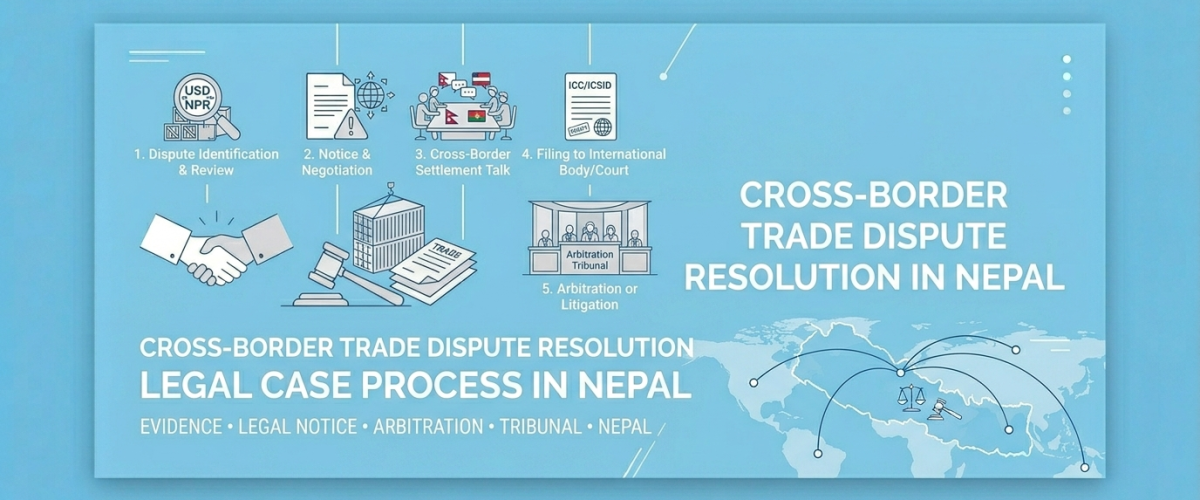

Cross border trade dispute resolution legal team Nepal has become essential for businesses engaged in international commerce. The legal framework governing cross border trade dispute resolution in Nepal is established through multiple statutes including the Arbitration Act 2055, Foreign Investment and Technology Transfer Act 2075, and Nepal’s commitments under WTO agreements. This comprehensive guide examines how specialized legal teams handle cross border trade disputes, the statutory provisions, institutional mechanisms, and strategic considerations for resolving international commercial conflicts.
Legal Framework for Cross Border Trade Dispute Resolution in Nepal
The cross border trade dispute resolution legal team Nepal operates within a multi-layered legal framework. The Arbitration Act 2055 serves as the cornerstone legislation for resolving international commercial disputes through arbitration. This statute was significantly amended in March 2025 through the Act to Amend Some Nepal Acts Relating to Improving Economic and Business Environment, introducing fast-track arbitration provisions under Section 13A.
Nepal acceded to the 1958 New York Convention on 4 March 1998, with the Convention entering into force on 2 June 1998. This accession enables enforcement of foreign arbitral awards from Convention member states, subject to reciprocity and commercial reservations.
The Foreign Investment and Technology Transfer Act 2075 provides specific dispute resolution mechanisms for cross border investment disputes. Section 40 mandates amicable settlement facilitation by the Department of Industry, followed by arbitration under UNCITRAL rules if disputes remain unresolved within forty-five days.
Key Statutes Governing Cross Border Trade Disputes
Multiple statutes govern cross border trade dispute resolution legal team Nepal operations. The Arbitration Act 2055 provides procedural frameworks for both domestic and international arbitration. The Act recognizes party autonomy, separability of arbitration clauses, and competence-competence principles.
The Foreign Investment and Technology Transfer Act 2075 establishes specific procedures for foreign investment disputes. Section 40 requires Department of Industry facilitation for amicable settlement, followed by arbitration if negotiations fail.
The Contract Act 2056 governs contractual disputes arising from cross border trade agreements. The Civil Procedure Code 2074 provides judicial enforcement mechanisms for arbitral awards and foreign judgments.
The Customs Act 2064 regulates import-export disputes, while the Banking and Financial Institution Act 2073 provides mediation mechanisms for inter-bank disputes through Nepal Rastra Bank intervention.
Role of Cross Border Trade Dispute Resolution Legal Team Nepal
A specialized cross border trade dispute resolution legal team Nepal provides comprehensive services across multiple domains. These teams typically comprise advocates with expertise in international arbitration, trade law specialists, and consultants familiar with WTO agreements and bilateral investment treaties.
Legal teams assist clients with arbitration clause drafting in international contracts, ensuring clear seat specifications, governing law selection, and procedural rule adoption. They represent parties before arbitral tribunals, District Courts for enforcement proceedings, and appellate courts for award challenges.
Cross border trade dispute resolution legal team Nepal professionals handle document preparation for foreign award enforcement, including certified translations, authentication procedures, and compliance verification with New York Convention requirements.
Types of Cross Border Trade Disputes
Cross border trade disputes in Nepal encompass various categories. International commercial arbitration involves disputes between Nepalese and foreign parties concerning construction projects, hydropower development, technology transfer, and foreign direct investment.
Investment treaty arbitration arises under bilateral investment treaties between Nepal and other countries. These disputes typically involve expropriation claims, unfair treatment allegations, and treaty interpretation matters.
WTO-related trade disputes involve Nepal’s rights and obligations under World Trade Organization agreements. While Nepal has not been involved in formal WTO dispute settlement cases during recent review periods, legal teams must understand these mechanisms for potential future engagements.
Contractual disputes arise from cross border purchase agreements, distribution arrangements, joint ventures, and technology licensing. These disputes are typically resolved through contractual arbitration clauses or institutional arbitration procedures.
Cross Border Trade Dispute Resolution Under FITTA
The Foreign Investment and Technology Transfer Act 2075 establishes a structured approach for cross border trade dispute resolution legal team Nepal handling investment conflicts. Section 40 creates a mandatory escalation pathway beginning with Department of Industry facilitation for amicable settlement.
The facilitation process requires the Department to coordinate mutual discussions between Nepalese and foreign investors within forty-five days of dispute arising. This administrative mechanism aims to preserve investment relationships while addressing grievances through government intervention before formal proceedings commence.
If facilitation fails, parties must follow their joint investment or dispute settlement agreement provisions. The Act requires parties to inform the Foreign Investment Approving Body about any settlement reached within fifteen days, though terms and conditions disclosure remains voluntary.
Where agreements lack dispute settlement provisions, arbitration under Nepal’s arbitration law becomes mandatory. The Act specifically mandates UNCITRAL rules application unless parties agree otherwise, with arbitration seated in Nepal applying Nepalese substantive law.
WTO Framework and Cross Border Trade Disputes
Nepal has been a WTO Member since 2004 and actively participates in the organization’s work. During recent review periods, Nepal was not involved in any cases under the WTO dispute settlement mechanism, nor did it participate in the Multi-Party Arbitration Arrangement.
Nepal grants at least MFN treatment to all trading partners and ratified the Agreement on Fisheries Subsidies in August 2025. The country expects to fully implement commitments under the Agreement on Trade Facilitation by 2032.
Cross border trade dispute resolution legal team Nepal professionals must understand WTO agreements including GATT, GATS, and TRIPS when advising clients on international trade compliance and potential dispute prevention strategies.
Bilateral Investment Treaties and Cross Border Disputes
Nepal has signed bilateral investment promotion and protection agreements with multiple countries, providing investor-state arbitration mechanisms. These treaties typically allow foreign investors to initiate arbitration against Nepal for treaty violations including expropriation without compensation, unfair treatment, and failure to provide full protection and security.
The ICSID Convention provides additional enforcement mechanisms for investment disputes involving Nepal. However, interim measures from investment tribunals may face enforcement challenges, as demonstrated in cases where ICSID orders restraining tax collection were not immediately treated as binding by Nepalese authorities.
Government contracts increasingly include arbitration clauses with sovereign immunity waivers. Infrastructure development agreements now contain express undertakings that the Government shall not assert immunity from legal proceedings or arbitration enforcement.
Institutional Arbitration for Cross Border Trade Disputes
The Nepal Council of Arbitration has administered arbitrations since the 1990s, offering established rules and experienced arbitrator panels. NEPCA specializes in construction, infrastructure, and commercial disputes involving cross border elements.
The Nepal International ADR Centre positions itself as a modern institution providing arbitration, mediation, and training services. NIAC is a founding member of the Asia Pacific Center for Arbitration and Mediation, enhancing its international credibility for cross border trade dispute resolution.
Both institutions offer facilities for hearings, case management services, and arbitrator appointment mechanisms. The choice between NEPCA and NIAC depends on dispute nature, party preferences, and required expertise for cross border trade matters.
Arbitration Procedures for Cross Border Trade Disputes
The arbitration process for cross border trade disputes follows structured procedures. Parties initiate arbitration through written notice referencing the arbitration clause. Arbitrators are appointed through party agreement or High Court intervention if appointment mechanisms fail.
The arbitral tribunal conducts preliminary hearings to establish procedural timelines, evidence procedures, and fee structures. Written submissions are exchanged, followed by oral hearings where witnesses are examined and expert evidence presented.
The tribunal issues a reasoned award within 120 days from final submission, extendable by 60 days. Awards are enforceable as District Court judgments under Section 34 of the Arbitration Act.
Enforcement of Foreign Arbitral Awards in Cross Border Trade Disputes
Foreign arbitral award enforcement in Nepal follows procedures established under Section 34 of the Arbitration Act and the New York Convention. Applications must be filed with the District Court having jurisdiction over the respondent’s residence or business location.
Required documentation includes original or certified award copies, original or certified arbitration agreements, and certified Nepali translations for foreign language documents. Proof of award finality and court fee payment are mandatory.
The Supreme Court in Hanil Engineering case established that foreign awards must satisfy appointment procedures agreed by parties and comply with notice requirements for fair hearings. Courts may refuse enforcement only on limited grounds including invalid arbitration agreements, lack of proper notice, awards exceeding arbitration scope, and public policy violations.
Recent Developments in Cross Border Trade Dispute Resolution
The March 2025 amendment to the Arbitration Act introduced significant reforms for cross border trade dispute resolution. Fast-track arbitration is now permitted under Section 13A, allowing expedited dispute resolution for time-sensitive commercial matters.
Section 30(4) now explicitly prohibits courts from re-examining evidence when adjudicating applications to invalidate awards. This strengthens award finality and reduces judicial intervention in arbitration proceedings.
Expedited enforcement provisions allow arbitral awards to be enforced within 15 days instead of the earlier 30-day period. This reform is particularly relevant for ad-hoc arbitration commonly practiced by state-owned enterprises and government departments.
Sector-Specific Cross Border Trade Dispute Resolution
Hydropower projects dominate cross border trade dispute resolution in Nepal due to significant foreign investment in this sector. Construction disputes arising from infrastructure development frequently involve international contractors and complex arbitration clauses addressing geological risks, currency fluctuations, and regulatory changes.
Information technology and telecommunications sectors show growing arbitration utilization for cross border service agreements and technology transfers. The Axiata case demonstrated the complexity of tax-related investment disputes in this sector.
Tourism and hospitality investments utilize arbitration for dispute resolution, particularly for hotel development and management agreements with foreign operators. Manufacturing joint ventures between Nepalese and foreign partners increasingly incorporate sophisticated dispute resolution mechanisms.
Costs and Timeline for Cross Border Trade Dispute Resolution
Cross border trade dispute resolution involves various cost components.
| Cost Category | Calculation Basis | Approximate Range (NPR) |
|---|---|---|
| Tribunal Fees | Per arbitrator/hour or fixed | 50,000 – 500,000 |
| Institutional Fees | Administrative charges | 25,000 – 150,000 |
| Legal Representation | Professional fees | 100,000 – 1,000,000 |
| Court Fees (Enforcement) | Percentage of award | 0.5% – 2% |
| Translation Costs | Per page certified | 500 – 2,000 |
Timeline expectations vary based on complexity. Standard arbitration may conclude within 6-12 months, while fast-track proceedings can resolve within 3-6 months. Enforcement proceedings add 6-18 months depending on court schedules and potential appeals.
Practical Challenges in Cross Border Trade Dispute Resolution
Cross border trade dispute resolution legal team Nepal professionals face several practical challenges. Ambiguous contract clauses in Standard Bidding Documents create interpretation disputes during enforcement. Government entity delays in arbitrator appointment extend resolution timelines unnecessarily.
Enforcement challenges against public entities require specific strategies. Budget constraints sometimes prevent immediate payment of awards, requiring separate execution proceedings. Low-bidding practices in procurement create performance disputes when contractors cannot deliver at quoted prices.
Recent amendments address some challenges through fast-track arbitration introduction and evidence re-examination prohibition. However, specialized commercial court creation remains under discussion to improve arbitration expertise within the judiciary.
Strategic Considerations for Cross Border Trade Dispute Resolution
Foreign investors and Nepalese businesses should engage experienced cross border trade dispute resolution legal team Nepal professionals familiar with international arbitration and enforcement procedures. Pre-contractual due diligence regarding arbitration clauses prevents future enforcement difficulties.
Strategic seat selection balances neutrality perceptions against enforcement practicalities. Singapore, London, or Dubai seats may enhance enforceability abroad while Kathmandu seats provide local procedural familiarity for disputes involving Nepalese parties.
Asset identification before dispute emergence facilitates effective post-award execution. Understanding local court procedures and judicial practices improves enforcement success rates for cross border trade awards.
Landmark Cases in Cross Border Trade Dispute Resolution
The Axiata Investments case demonstrated Nepal’s successful defense against a 422 million dollar investor-state arbitration. The dispute involved capital gains tax imposition on Axiata’s acquisition of Nepal’s largest telecommunications provider. The tribunal rejected Axiata’s core claims and deferred to Nepal’s Supreme Court rulings upholding the tax.
The Hanil Engineering case established that the law governing the arbitration agreement must be independently established based on facts and circumstances, not presumed to be the same as the contract governing law. This clarified separability principles for cross border contracts.
The Sanghi Brothers case demonstrated reciprocity requirements for enforcement, with the Supreme Court refusing Indian award enforcement due to absence of formal reciprocity notification under Indian law.
Strategic Drafting for Cross Border Trade Contracts
Effective cross border trade contracts require careful dispute resolution clause drafting. Clear seat specification determines supervisory jurisdiction and applicable procedural law. Seat selection impacts enforcement strategies and perceived neutrality in international transactions.
Governing law provisions should address both substantive contract matters and arbitration agreement validity. The Hanil case established that contract governing law does not automatically apply to arbitration clauses, requiring explicit drafting.
Institutional rule selection provides procedural certainty. ICC, UNCITRAL, SIAC, LCIA, NEPCA, or NIAC rules offer established frameworks for cross border disputes. Emergency relief provisions and interim measure language should be explicitly included for time-sensitive matters.
Multi-tiered dispute resolution clauses are increasingly common, requiring negotiation, mediation, and arbitration phases before formal proceedings. These clauses must be drafted carefully to avoid ambiguity regarding preconditions to arbitration.
Frequently Asked Questions About Cross Border Trade Dispute Resolution Legal Team Nepal
What is the primary law governing cross border trade dispute resolution in Nepal?
The Arbitration Act 2055 serves as the primary legislation, supplemented by the Foreign Investment and Technology Transfer Act 2075 for investment-related disputes and Nepal’s commitments under the New York Convention.
How does a cross border trade dispute resolution legal team Nepal assist foreign investors?
Legal teams provide arbitration clause drafting, tribunal representation, award enforcement assistance, and strategic advice on seat selection and governing law for international contracts.
What is the role of the Department of Industry in cross border investment disputes?
The Department facilitates amicable settlement through mutual discussions within forty-five days. If unsuccessful, disputes proceed to arbitration under UNCITRAL rules or party-agreed mechanisms.
Which courts have jurisdiction to enforce foreign arbitral awards in Nepal?
District Courts having territorial jurisdiction over the respondent’s residence or business location enforce foreign arbitral awards. Appeals proceed to the Appellate Court and subsequently the Supreme Court.
What are the grounds for refusing enforcement of foreign awards?
Refusal grounds include invalid arbitration agreements, lack of proper notice, awards exceeding arbitration scope, non-arbitrable subject matters, and public policy violations.
Can interim measures be obtained during cross border trade arbitration?
Yes. Arbitral tribunals may grant interim measures, though District Court assistance is required for compulsory enforcement. High Courts may grant interim relief before tribunal constitution.
What types of cross border trade disputes are not arbitrable in Nepal?
Non-arbitrable matters include criminal proceedings, matters involving sovereign functions, and disputes violating Nepalese public policy or mandatory laws.
What is fast-track arbitration for cross border trade disputes?
Fast-track arbitration, introduced in March 2025 under Section 13A, allows expedited dispute resolution through streamlined procedures for time-sensitive commercial disputes.
How are arbitrators appointed in cross border trade disputes involving Nepal?
Parties may agree on appointment methods. Default appointments occur through High Court intervention when agreed methods fail. The Supreme Court upheld High Court appointment authority in relevant precedents.
What documentation is required for enforcing foreign arbitral awards in Nepal?
Required documents include original or certified award copies, original or certified arbitration agreements, certified Nepali translations for foreign language documents, proof of award finality, and court fee receipts.
What is the significance of the Axiata case for cross border trade dispute resolution?
The Axiata case established Nepal’s successful defense of sovereign taxation authority against investor claims, demonstrating that international arbitration tribunals defer to domestic Supreme Court interpretations of local law.
How does the New York Convention affect cross border trade dispute resolution in Nepal?
The New York Convention enables recognition and enforcement of foreign arbitral awards from Convention member states, providing certainty for international trade and investment.
Disclaimer: This guide provides general information about cross border trade dispute resolution legal team Nepal and does not constitute legal advice. Specific cases require consultation with qualified legal professionals. Laws and procedures are subject to change.
References and Authority Backlinks
For authoritative information on international arbitration frameworks, visit the United Nations Commission on International Trade Law (UNCITRAL). The New York Convention provides comprehensive resources on foreign award enforcement.
The International Chamber of Commerce (ICC) offers institutional arbitration rules widely used in international contracts. The Singapore International Arbitration Centre (SIAC) provides Asia-Pacific arbitration services.
For Nepalese legal resources, consult the Supreme Court of Nepal for judicial decisions. The Department of Industry maintains foreign investment and dispute resolution guidelines.
The Nepal Council of Arbitration (NEPCA) and Nepal International ADR Centre (NIAC) provide institutional arbitration services within Nepal for cross border trade disputes.
For international arbitration best practices, reference the International Bar Association (IBA) guidelines and the Chartered Institute of Arbitrators (CIArb) professional standards.
About Sunshine Law Firm
Sunshine Law Firm provides comprehensive cross border trade dispute resolution legal team Nepal services. With decades of combined experience, our legal team assists clients with arbitration clause drafting, tribunal formation, proceedings management, and award enforcement. Contact us for expert guidance on cross border trade dispute resolution matters involving Nepalese jurisdictions.
Updated on: March 21, 2025

