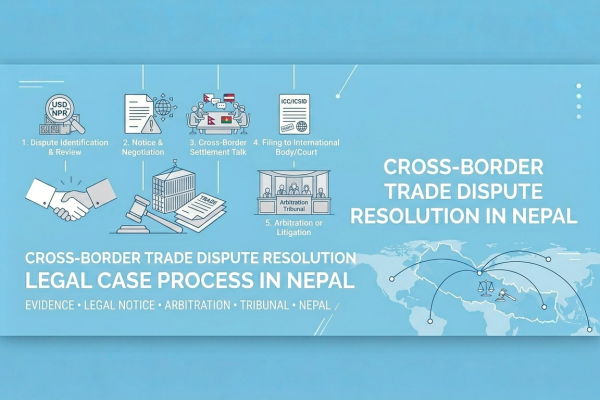


Introduction to Commercial Arbitration in Nepal
Commercial arbitration Process in Nepal has emerged as a preferred alternative dispute resolution mechanism for businesses seeking efficient and confidential resolution of commercial disputes. Governed primarily by the Arbitration Act, 2055 (1999), which incorporates principles from the UNCITRAL Model Law, Nepal’s arbitration framework provides a structured yet flexible approach to resolving commercial conflicts outside traditional court systems.
The arbitration process in Nepal is designed to offer parties greater control over dispute resolution while ensuring enforceability of outcomes. This comprehensive guide examines the entire commercial arbitration landscape in Nepal, from initiation to enforcement, providing valuable insights for both domestic and international businesses operating in Nepal’s growing market.
Legal Framework Governing Commercial Arbitration in Nepal
The Arbitration Act, 2055 (1999)
The Arbitration Act, 2055 serves as the cornerstone of Nepal’s commercial arbitration framework. Enacted to align with international standards, this legislation incorporates key principles from the UNCITRAL Model Law while addressing Nepal’s specific legal context. The Act establishes the legal foundation for:
- Recognition and enforcement of arbitration agreements
- Appointment of arbitrators and conduct of proceedings
- Interim measures and protection of rights
- Recognition and enforcement of arbitral awards
- Limited grounds for challenging awards
The Arbitration Rules, 2060 (2003)
Complementing the Arbitration Act, the Arbitration Rules, 2060 provide detailed procedural guidelines for conducting arbitrations in Nepal. These rules establish:
- Specific timelines for various stages of arbitration
- Requirements for written submissions and evidence
- Procedures for hearings and witness examination
- Standards for award formulation and delivery
Institutional Arbitration Frameworks
Several institutions in Nepal provide structured arbitration services, including:
- The Nepal Commercial Arbitration Center (NCAC)
- The Federation of Nepalese Chambers of Commerce and Industry (FNCCI)
- Specialized industry-specific arbitration bodies
These institutions have developed their own rules that operate within the framework of the Arbitration Act, offering parties additional procedural options and administrative support.
Also Read
- FDI repatriation process in Nepal
- Education Consultancy Registration in Nepal
- Manpower License in Nepal
- Divorce lawyer in Nepal
- Criminal lawyer in Nepal
- Education consultancy registration process in Nepal
The Commercial Arbitration Process in Nepal: Step-by-Step
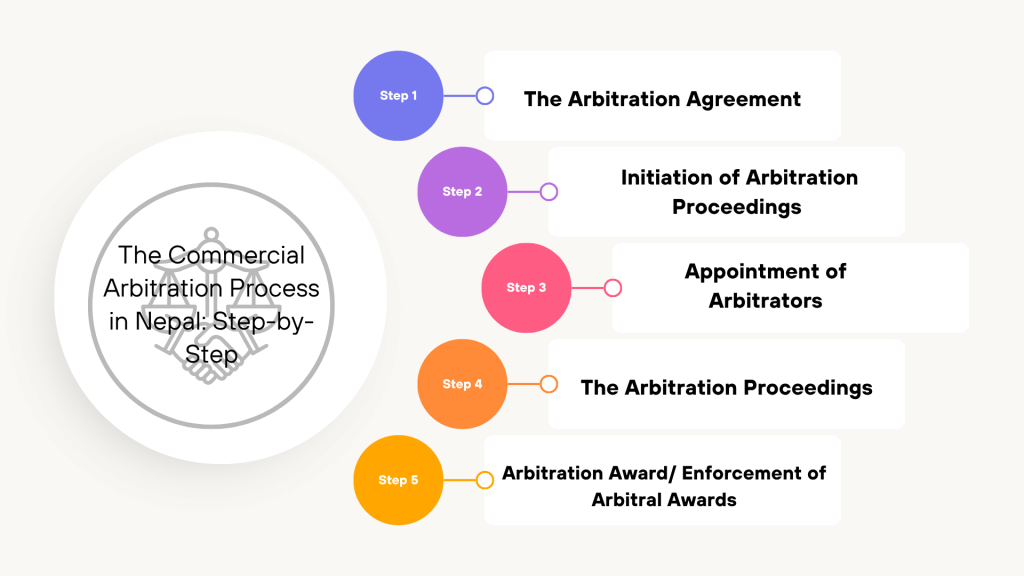
Step 1: The Arbitration Agreement
Commercial arbitration in Nepal begins with a valid arbitration agreement. This agreement must be in writing and may exist as:
- A clause within a commercial contract
- A separate agreement signed after a dispute has arisen
- An exchange of letters, telex, telegrams, or other means of telecommunications providing a record of the agreement
The agreement should clearly specify:
- The scope of disputes subject to arbitration
- The number of arbitrators
- The method of appointing arbitrators
- The seat of arbitration
- The language of proceedings
- Any specific procedural rules to be followed
Step 2: Initiation of Arbitration Proceedings
The arbitration process is formally initiated when the claimant submits a notice of arbitration to the respondent. This notice must include:
- The names and addresses of the parties
- Reference to the arbitration agreement
- A statement of the nature of the dispute
- The relief sought
- The proposed number of arbitrators
The notice is typically served within the time limits specified in the arbitration agreement or, in the absence of such specification, within a reasonable time.
Step 3: Appointment of Arbitrators
The formation of the arbitral tribunal is a critical stage in the commercial arbitration process in Nepal. The Arbitration Act provides flexibility in appointing arbitrators:
- Parties may agree on a sole arbitrator
- Parties may appoint three arbitrators (each party appointing one, and the two appointed arbitrators selecting the third)
- If parties cannot agree on the appointment procedure, the court may intervene upon request
Arbitrators must be independent and impartial, with the Act providing specific grounds for challenging an arbitrator’s appointment.
Step 4: The Arbitration Proceedings
Once the tribunal is constituted, the arbitration proceedings commence. These proceedings are characterized by:
- Greater flexibility than court litigation
- Confidentiality of the process
- Party autonomy in determining procedures
- Limited judicial intervention
The tribunal conducts proceedings based on the agreement of the parties or, in the absence of agreement, according to the powers conferred by the Arbitration Act. Key aspects include:
- Exchange of written statements of claim and defense
- Submission of documentary evidence
- Witness testimony and expert reports
- Hearings (if requested by the parties)
Step 5: The Arbitral Award
The culmination of the arbitration process in Nepal is the issuance of an arbitral award. The award must:
- Be in writing
- Be signed by the arbitrator(s)
- State the reasons upon which it is based (unless the parties have agreed otherwise)
- Specify the date and place of the award
- Be final and binding on the parties
The Act requires that awards be made within the time limit agreed by the parties or, in the absence of agreement, within four months from the date the tribunal is constituted, though this period may be extended with the parties’ consent.
- Company Registration in Nepal
- E- commerce company registration in Nepal
- Loan Recovery process in Nepal
- Export Import License in Nepal
- FDI Process in Nepal
- Construction License process in Nepal
Step 6: Enforcement of Arbitral Awards
A significant advantage of commercial arbitration in Nepal is the enforceability of arbitral awards. Under the Arbitration Act:
- An arbitral award is recognized as binding and enforceable as a decree of a court
- Enforcement applications must be made to the court having jurisdiction
- The court may refuse enforcement only on limited grounds specified in the Act
These limited grounds include:
- Incapacity of parties or invalidity of the arbitration agreement
- Failure to receive proper notice of appointment or proceedings
- The award deals with a dispute not contemplated by the arbitration agreement
- The award is in conflict with the public policy of Nepal
- The award has been set aside or suspended by a competent authority
Timeline and Costs of Commercial Arbitration in Nepal
Typical Arbitration Timeline
While the exact timeline varies based on case complexity, a typical commercial arbitration process in Nepal follows this approximate schedule:
| Stage | Typical Duration |
|---|---|
| Initiation to tribunal formation | 30-60 days |
| Exchange of pleadings | 45-90 days |
| Evidence gathering and disclosure | 60-120 days |
| Hearings (if required) | 1-5 days |
| Award issuance | 30-90 days after hearings |
| Total process | 6-12 months |
Cost Structure of Arbitration
The costs associated with commercial arbitration in Nepal typically include:
| Cost Component | Description |
|---|---|
| Arbitrator fees | Based on complexity and amount in dispute |
| Administrative fees | Charged by arbitration institutions |
| Legal representation | Counsel fees for both parties |
| Expert witness fees | If technical expertise is required |
| Hearing expenses | Venue, transcription, etc. |
While arbitration may involve higher upfront costs than litigation, many businesses find the overall value proposition favorable due to faster resolution and greater enforceability.
Advantages and Challenges of Commercial Arbitration in Nepal
Key Advantages
Commercial arbitration in Nepal offers several distinct advantages over traditional litigation:
- Neutrality: Parties can select neutral arbitrators and venues
- Expertise: Arbitrators with specific industry knowledge can be appointed
- Confidentiality: Proceedings and outcomes remain private
- Flexibility: Procedures can be tailored to suit the dispute
- Finality: Limited grounds for appeal provide greater certainty
- Enforceability: Awards are enforceable as court decrees
- International Recognition: Nepal is a signatory to the New York Convention
Current Challenges
Despite these advantages, certain challenges persist in Nepal’s arbitration landscape:
- Limited awareness among some business sectors
- Developing institutional capacity
- Occasional judicial reluctance to fully embrace arbitration
- Need for more specialized arbitrators in certain technical fields
Recent Developments and Future Trends
Legislative Amendments
Recent amendments to the Arbitration Act, 2055 have strengthened Nepal’s arbitration framework by:
- Clarifying procedures for interim measures
- Enhancing provisions for enforcement of foreign awards
- Streamlining challenges to arbitral awards
- Expanding the scope of arbitrable disputes
Institutional Growth
The growth of specialized arbitration institutions, particularly the Nepal Commercial Arbitration Center (NCAC), has significantly improved the infrastructure supporting commercial arbitration in Nepal. These institutions provide:
- Standardized rules and procedures
- Administrative support
- Panel of qualified arbitrators
- Hearing facilities
International Integration
Nepal’s continued integration into the global economy has increased the importance of having a robust commercial arbitration process in Nepal. Recent developments include:
- Greater alignment with international best practices
- Increased participation of Nepali arbitrators in international proceedings
- Growing recognition of Nepal as a neutral venue for regional disputes
Practical Considerations for Parties
Drafting Effective Arbitration Agreements
To ensure a smooth arbitration process in Nepal, parties should consider:
- Clearly defining the scope of arbitrable disputes
- Specifying the number and method of appointing arbitrators
- Determining the seat and language of arbitration
- Selecting appropriate procedural rules
- Addressing potential cost allocation
Preparing for Arbitration
Effective preparation for commercial arbitration includes:
- Early assessment of the dispute’s merits
- Preservation of relevant evidence
- Selection of appropriate legal representation
- Consideration of settlement possibilities throughout the process
Enforcement Considerations
To enhance the enforceability of arbitral awards:
- Ensure compliance with procedural requirements
- Consider the public policy implications of the dispute
- Maintain detailed records of the arbitration process
5. Data Tables
Comparison: Commercial Arbitration vs. Court Litigation in Nepal
| Aspect | Commercial Arbitration | Court Litigation |
|---|---|---|
| Time to Resolution | 6-12 months | 2-5 years |
| Confidentiality | High | Low (public proceedings) |
| Party Autonomy | High (procedure, arbitrators) | Limited (court procedures) |
| Appeal Options | Very limited | Multiple appeal stages |
| Enforceability | Enforceable as court decree | Direct court enforcement |
| International Recognition | High (New York Convention) | Variable |
| Cost Structure | Higher upfront costs | Lower initial costs but potentially higher overall |
Arbitration Institutions in Nepal
| Institution | Established | Specialization | Key Features |
|---|---|---|---|
| Nepal Commercial Arbitration Center (NCAC) | 1999 | General commercial disputes | Comprehensive rules, international standards |
| FNCCI Arbitration Center | 2005 | Trade and industry disputes | Industry-specific expertise |
| Nepal Bar Association Arbitration Committee | 2003 | General commercial disputes | Legal profession oversight |
6. FAQ Section
What types of commercial disputes can be arbitrated in Nepal?
Contract disputes relating to international trade, construction, joint ventures, and distribution
Intellectual property licensing disputes
Banking and financial services disputes
Insurance claims
Investment disputes
Technology and software licensing agreements
Energy and natural resources agreements
However, certain matters are excluded from arbitration, including criminal matters, family law issues, and matters concerning public policy.
How long does the commercial arbitration process typically take in Nepal?
Simple disputes may be resolved within 6 months
More complex commercial disputes typically take 9-12 months
The Arbitration Act specifies a default period of 4 months for award issuance, though this can be extended with party consent
Factors affecting duration include the complexity of issues, availability of arbitrators, and cooperation between parties
Are arbitral awards issued in Nepal enforceable internationally?
Nepal is a signatory to the New York Convention on the Recognition and Enforcement of Foreign Arbitral Awards
Awards issued in Nepal can be enforced in over 160 countries that are party to the Convention
Similarly, foreign arbitral awards can be enforced in Nepal under the same framework
This international enforceability makes commercial arbitration in Nepal particularly attractive for cross-border transactions
What are the costs associated with commercial arbitration in Nepal?
Arbitrator fees: Usually calculated as a percentage of the claim amount or based on hourly rates
Administrative fees: Charged by arbitration institutions for case management
Legal representation: Fees for counsel representing the parties
Expert witness fees: If technical expertise is required
Hearing expenses: Including venue rental, transcription services, etc.
Can an arbitral award be challenged in Nepal courts?
The arbitration agreement is invalid or the parties lacked capacity
There was improper notice or inability to present a case
The award deals with matters beyond the scope of the arbitration agreement
The award is in conflict with the public policy of Nepal
The composition or proceedings of the tribunal were not in accordance with the agreement of the parties
The limited grounds for challenge reflect the principle of finality in arbitration and prevent excessive judicial interference.
7. Conclusion
Commercial arbitration in Nepal offers businesses an efficient, flexible, and enforceable mechanism for resolving commercial disputes. With a legal framework aligned with international standards and growing institutional support, Nepal is developing into a reliable venue for both domestic and international commercial arbitration.
For businesses operating in Nepal’s growing economy, understanding the commercial arbitration process in Nepal is essential for effective risk management and dispute resolution planning. By incorporating well-drafted arbitration agreements into commercial contracts and developing familiarity with Nepal’s arbitration landscape, businesses can position themselves to resolve disputes efficiently while preserving business relationships.
Call to Action: If you’re facing a commercial dispute in Nepal or wish to incorporate arbitration clauses in your business agreements, consult with our experienced arbitration team. We provide comprehensive guidance on navigating Nepal’s arbitration landscape, from drafting effective arbitration agreements to representing clients throughout the arbitration process. Contact us today for a consultation tailored to your specific business needs.