
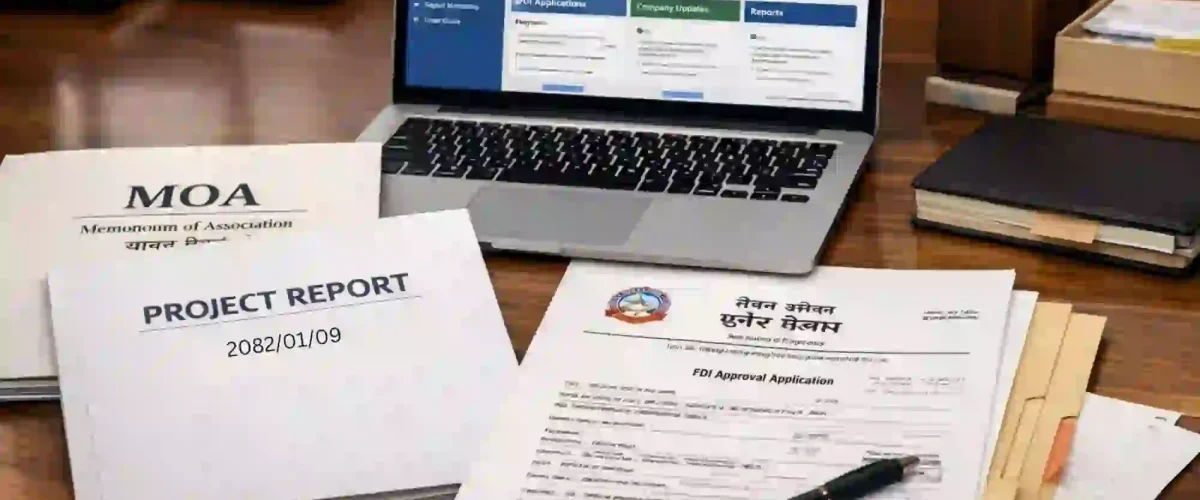
FDI Approval Advisory (DOI & IBN)
FDI approval in Nepal is the mandatory regulatory authorization for foreign investors to establish or acquire businesses, governed by the Foreign Investment and Technology Transfer Act 2075. The Department of Industry (DOI) approves investments up to NPR 6 billion; Investment Board Nepal (IBN) handles larger projects. Approval typically takes 7-15 days officially, 1-2 months practically. Sunshine Law Firm provides end-to-end FDI advisory from application through capital injection compliance.
What is FDI Approval in Nepal?
FDI approval is the mandatory preliminary authorization that foreign investors must obtain from Nepali authorities before establishing a company, acquiring equity, or making other regulated investments in Nepal. Under the Foreign Investment and Technology Transfer Act 2075 (2019) (FITTA), this approval establishes the legal basis for foreign capital inflow, company registration, and subsequent profit repatriation .
The Department of Industry (DOI) approves foreign investments not exceeding NPR 6 billion, while the Investment Board Nepal (IBN) approves investments exceeding NPR 6 billion or hydropower projects above 200 MW capacity . FITTA Section 17 establishes this jurisdictional division. Foreign investors include non-resident Nepalis (NRNs), who are classified as foreign investors under the Act .
Without valid FDI approval, foreign capital cannot be legally injected, companies cannot be registered with foreign shareholding, and profits cannot be repatriated. Operating without approval exposes investors to penalties, invalidation of shareholder rights, and inability to enforce contracts. The automatic route (introduced 2023) allows immediate online approval for qualifying sectors (energy, IT, tourism, infrastructure) up to NPR 500 million without prior bureaucratic review
Our FDI Approval Advisory Services
Sunshine Law Firm handles FDI approval end-to-end in Nepal, from initial sector eligibility verification through final Nepal Rastra Bank investment recording and repatriation setup.
• Sector Eligibility & Negative List Review, Verification that proposed investment is not on FITTA Schedule (prohibited sectors: primary agriculture, cottage industries, personal services, arms, real estate)
• DOI FDI Application Preparation, Complete application drafting for investments up to NPR 6 billion, including project reports, financial credibility certificates, and source of investment documentation
• IBN Large Project Advisory, Specialized application handling for investments exceeding NPR 6 billion or strategic infrastructure projects requiring Investment Board approval
• Automatic Route Eligibility Assessment, Determination whether investment qualifies for online automatic approval (energy, IT, tourism, infrastructure up to NPR 500 million)
• Document Authentication & Legalization, Coordination of foreign document notarization, apostille, and embassy verification for investor credentials
• Company Registration Coordination, Liaison with Office of Company Registrar (OCR) for MOA/AOA drafting, name reservation, and foreign-shareholding company incorporation
• Capital Injection Compliance, Guidance on tiered investment injection schedules (25% Year 1 for up to NPR 500M, etc.) and NRB reporting requirements
• Post-Approval Compliance Management, Industry registration, PAN/VAT setup, Social Security Fund registration, and ongoing regulatory maintenance
• Repatriation Structure Advisory, Setup of dividend, royalty, and capital gain repatriation mechanisms through Nepal Rastra Bank channels
How FDI Approval Works ,Step by Step
The FDI approval process in Nepal generally involves 9 key steps, handled through the Department of Industry (DOI) for standard investments or Investment Board Nepal (IBN) for large projects.
Step 1: Sector Eligibility Verification (1-3 days) Confirm proposed business is not on FITTA negative list (Schedule). Sunshine Law Firm reviews sector classification under Industrial Enterprises Act 2076.
Step 2: Investment Structure Planning (2-5 days) Determine optimal investment form: 100% foreign subsidiary, joint venture, or branch office. Select approving body based on investment amount threshold (DOI: under NPR 6B; IBN: over NPR 6B)
Step 3: Document Preparation (1-2 weeks) Prepare project proposal, investor bio-data/company profile, registration documents, corporate resolution, financial credibility certificate, source of funds declaration, and Power of Attorney.
Step 4: FDI Application Submission (Day 1) Submit application to DOI (automatic route online or standard manual) or IBN with complete documentation and government fees.
Step 5: Authority Review & Approval (7-15 days official; 2-4 weeks practical) DOI must decide within 7 days; IBN within 15 days. Authorities may request additional information during review.
Step 6: FDI Approval Certificate Issuance (1-3 days) Upon approval, receive official FDI Approval Certificate specifying investment amount, timeline, and conditions.
Step 7: Company Registration at OCR (1-2 weeks) Register company with foreign shareholding at Office of Company Registrar, submitting MOA, AOA, and FDI Approval Certificate.
Step 8: Capital Inflow & NRB Approval (2-4 weeks) Open foreign currency account, inject investment through banking channels, obtain Investment Inflow Certificate from bank, and secure NRB final approval for capital recording.
Step 9: Operational Registration (1-2 weeks) Complete industry registration at DOI, PAN/VAT registration, and local municipality business registration.
Total processing time generally ranges from 1 to 2 months for complete FDI approval and company establishment, depending on document preparation speed, authority responsiveness, and whether automatic route eligibility applies.
Documents Required
The following documents are typically required for FDI approval in Nepal, categorized by investor type:
For Foreign Individual Investors:
- Valid passport (copy of biodata page and relevant visas)
- Detailed bio-data/curriculum vitae
- Financial credibility certificate from bank in home country
- Source of investment funds declaration
- Project report with business plan, market analysis, technical specifications, and financial projections
- Commitment letter stating investment will not be repatriated within first year
- Power of Attorney authorizing Nepali representative (if applicable)
For Foreign Corporate Investors:
- Certificate of incorporation/registration (authenticated/apostilled)
- Memorandum and Articles of Association
- Corporate resolution authorizing investment in Nepal
- Board of Directors list with passport copies
- Audited financial statements (last 2-3 years)
- Financial credibility certificate from corporate bank
- Corporate profile and business activities description
For Joint Ventures:
- Joint Venture Agreement between foreign and Nepali partners
- Nepali partner’s citizenship certificate and company documents (if corporate)
- Detailed shareholding structure and capital contribution schedule
Additional Requirements for All Applications:
- Time schedule for capital injection into Nepal
- Action plan for industry establishment and operation
- Technology transfer agreement (if applicable)
- Environmental impact assessment (for specified industries)
Note: All foreign documents must be notarized, apostilled (if country is Hague Convention member), and legalized at relevant Nepali embassy/consulate.
Timeline and Government Fees
The FDI approval process in Nepal typically takes 1 to 2 months from application submission through final NRB investment recording, subject to government processing times and document completeness.
Official Timeline:
- DOI decision: 7 days from application receipt (FITTA Section 15(2))
- IBN decision: 15 days for large projects
- Ministry review (if DOI rejects): 30 days
Practical Timeline:
- Document preparation: 1-2 weeks
- Authority review and approval: 2-4 weeks
- Company registration (OCR): 1-2 weeks
- Bank account opening and capital injection: 1-2 weeks
- NRB final approval: 1-2 weeks
Government Fees:
- FDI application fee: Varies by investment amount (confirm current rates with DOI/IBN)
- Company registration (OCR): NPR 9,500 minimum depending on authorized capital
- Industry registration: Based on capital investment
- PAN/VAT registration: Nominal fees
Professional Fees: Our fees vary based on case complexity, investment structure, and required advisory scope. Contact us for a transparent quote including all government liaison and document preparation.
Expedited Processing: Automatic route (online) provides immediate preliminary approval for qualifying sectors without manual review . Standard applications may be expedited through direct liaison with DOI/IBN officials where justified.
Why Use Sunshine Law Firm for FDI Approval
Our lawyers have handled numerous FDI approval matters for foreign investors across manufacturing, technology, tourism, energy, and infrastructure sectors, successfully navigating both DOI standard processes and IBN large-project approvals.
Sunshine Law Firm maintains active professional relationships with Department of Industry officials, Investment Board Nepal secretariat, and Nepal Rastra Bank foreign investment departments. Our team has specific expertise in FITTA 2075 compliance, automatic route eligibility assessment, and March 2025 amendment advisory regarding equity transfer restrictions
Common mistakes clients avoid by using our advisory: selecting wrong approval body (DOI vs. IBN), submitting incomplete project reports that trigger rejection, missing investment injection deadlines that invalidate approval, and failing to structure repatriation mechanisms at the approval stage. We ensure sector eligibility is confirmed before application, documents meet authentication standards, and capital injection schedules align with investor cash flow.
We prioritize transparent process tracking, direct authority liaison, and proactive compliance management to prevent approval delays and regulatory complications.
Disclaimer: This content is for general informational purposes only and does not constitute legal advice. Laws and procedures in Nepal may change; please consult a qualified Nepali lawyer for advice specific to your situation. Sunshine Law firm does not accept liability for actions taken based solely on this content.
Frequently Asked Questions
Officially, DOI must decide within 7 days and IBN within 15 days . Practically, complete FDI approval through company registration and NRB clearance takes 1-2 months depending on document preparation and authority responsiveness.
Government fees vary by investment amount and company capital structure. Company registration at OCR starts at NPR 9,500. Professional advisory fees depend on case complexity. Contact us for detailed cost breakdown.
Required documents include: project report, investor passport/company registration, financial credibility certificate, source of funds declaration, corporate resolution, commitment letter (no repatriation for 1 year), and Power of Attorney . Joint ventures require JV agreements.
Yes. FITTA allows 100% foreign ownership in most sectors . Only specific sectors have caps (e.g., telecommunications 80%, banking 20-85%, ride-sharing 70%). Negative list sectors (primary agriculture, cottage industries, personal services, arms, real estate) prohibit FDI entirely
Current minimum is NPR 20 million (~USD 150,000) for most sectors . No minimum applies to IT sector under automatic route (as of May 2023) . Large projects exceeding NPR 6 billion require IBN approval.
DOI (Department of Industry) approves foreign investments up to NPR 6 billion . IBN (Investment Board Nepal) approves investments exceeding NPR 6 billion or hydropower projects above 200 MW . IBN serves as one-stop service center under Investment Board Act 2068.
FITTA Section 43 deems approval ipso facto ineffective if capital injection does not commence within 2 years of approval. Tiered injection requirements apply: 25% Year 1 for up to NPR 500M, 15% for NPR 500M-2.5B, etc. .
Bringing foreign investment into Nepal without a valid Foreign Investment Approval Certificate from DoI or IBN is a breach of FITTA 2019 and Nepal Rastra Bank foreign exchange regulations. Commercial banks are required to verify the FDI certificate before accepting equity remittances without it, the bank will not process the transfer for equity purposes. If funds enter through other channels without approval, they may be classified as an unauthorised remittance, creating compliance problems that directly affect the company's ability to repatriate profits in the future.
Prohibited sectors under FITTA 2019 include arms and ammunition manufacturing, radioactive materials, cottage and small industries reserved for Nepali nationals, personal service businesses (e.g., beauty salons, tailoring, driving instruction), retail trading below a minimum threshold, and primary agriculture for domestic consumption. Several other sectors have foreign equity caps rather than outright prohibition — financial services, consulting, health services, and ride-sharing (capped at 70% foreign ownership since 2024) all limit how much of the company a foreign investor can own. Confirm your sector's current status before structuring the investment.